


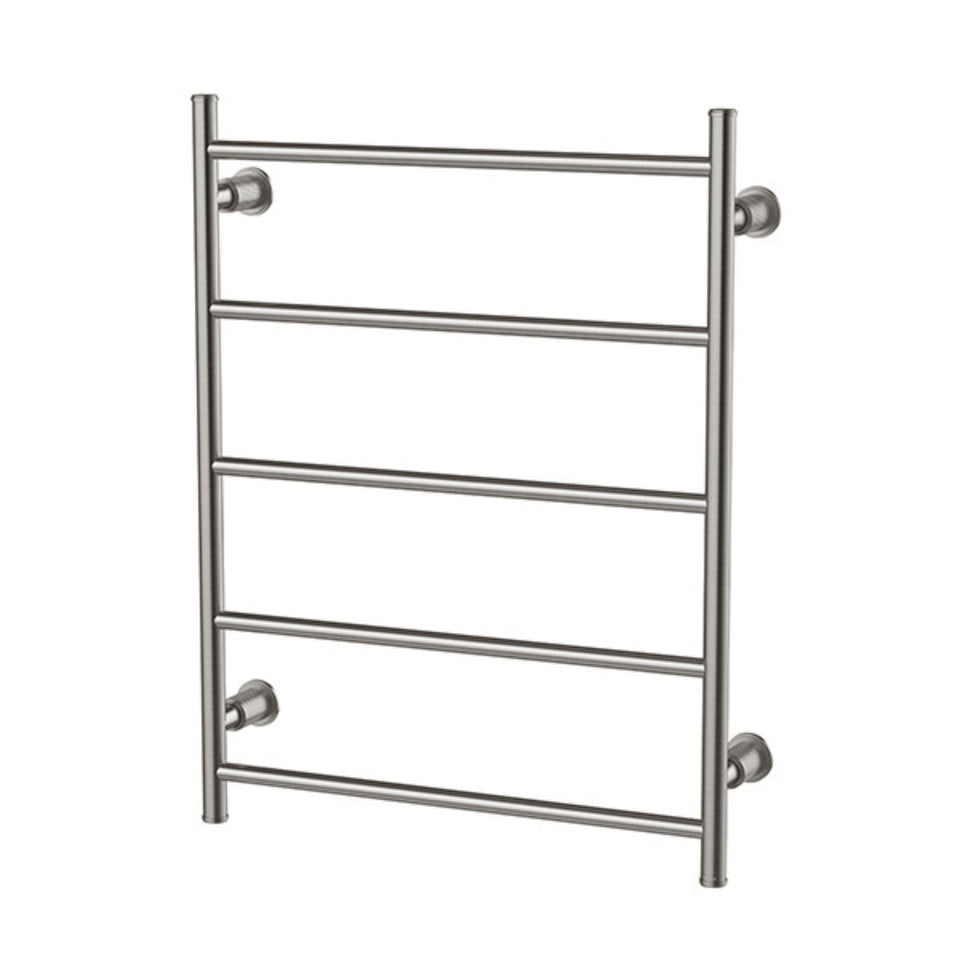
240 Volt Heated Towel Rails Buying Guide
Running on mains power rather than a low-voltage transformer, a 240V rail heats considerably faster than a 12V equivalent, making it the genuine standard for a new bathroom build where the electrical rough-in can be planned from the outset.
Choosing a configuration
Single bar rails suit a compact bathroom or a secondary hand-towel spot. Ladder-style rails, spanning 3 through to 11 bars, give genuinely more drying capacity within a narrow wall footprint, well suited to a family bathroom needing to dry several towels at once. In-wall panel towel dryers, a genuinely different format from a standard rail, sit flush within the wall for a minimal, streamlined look, worth considering for a bathroom prioritising a clean, uncluttered wall.
A closer look at named products
Thermogroup's range is genuinely extensive: 8-bar ladders at 400mm, 530mm and 750mm, a 7-bar rail at 600mm across polished stainless steel, white satin, matte black, brushed gold, brushed stainless and brushed nickel, a 10-bar ladder at 700mm in polished stainless steel and matte black (including a wide straight round option), a 4-bar round ladder at 550mm in black, polished stainless and brushed brass, and a 3-bar ladder at 550mm. Thermogroup's Thermorad in-wall panel towel dryer offers a genuinely distinct, flush-mounted alternative to a standard rail. Radiant's round ladders span 430mm, 600mm and 750mm widths, up to 1200mm tall, across polished stainless steel, brushed nickel, brushed gold, matte black and gunmetal. Phoenix's Radii 550mm round-plate ladder and Meir's heated vertical towel rail round out the collection in brushed nickel.
Choosing a shape and finish
This collection spans oval, round and square profiles, in chrome, matte black, white, gunmetal, brushed gold, brushed nickel and stainless steel, giving genuine flexibility to match the rail to the room's existing tapware and accessories.
What is the difference between a towel rail and a heated towel rail?
A standard towel rail is an unheated, wall-mounted rail for hanging and airing towels. A heated towel rail incorporates an electric or hydronic heating element that warms the rail surface. Standard towel rails are more affordable and simpler to install, while heated towel rails add warmth and faster drying.
What size heated towel rail do I need?
Heated towel rail sizes are measured by total width, typically 450mm to 900mm for a single rail, and up to 1200mm for wider ladder-style units. A 600mm rail suits a single bathroom with one or two towels, while a 900mm ladder rail is ideal for a family bathroom. Vertical ladder-style rails offer more drying capacity within a narrower wall footprint.
Can I install a heated towel rail myself?
Surface-mounted heated towel rails that plug into a standard power point can be installed without an electrician. Hardwired heated towel rails, which connect directly to the mains without a visible plug, must be installed by a licensed electrician under Australian law. Always check the installation requirements of the chosen model before purchasing, since a 240V rail is more commonly hardwired than a 12V equivalent.
Are electric heated towel rails expensive to run in Australia?
Most electric heated towel rails use between 60W and 150W, comparable to a standard light bulb. Run for 2 to 3 hours a day, a 100W rail costs around 8 to 12 cents per day at average Australian electricity rates. Using a timer to run the rail only when needed significantly reduces running costs.
What is a heated towel rail and how does it work?
A heated towel rail is a wall-mounted rail that uses either electric elements or a hydronic (hot water) connection to warm the rail surface, drying and warming towels placed on it. Electric heated towel rails are the most common in Australian bathrooms, connected to a standard power point or hardwired, and controlled with a switch or timer.
Completing the bathroom
A 240V heated towel rail is easiest to plan alongside the bathroom's electrical rough-in, since a hardwired rail needs its wiring run before walls are lined and tiling begins. The Blue Space's Bathroom Accessories and Bathroom Vanities collections are worth reviewing alongside a rail selection to bring the full room together.

