


Door locks and latches buying guide
A latch holds a door closed, a lock secures it, and the two are often confused. This collection holds the locking half of door hardware: single and double cylinder deadbolts, deadlatches, Euro mortice locks and cylinders, roller locks, double turn lock kits and smart locks, from Lockwood, Lane, Zanda, Nidus, Yale and others, in stainless steel, zinc alloy, brass and brass-plated finishes. This guide explains the difference between a latch, a lock, a deadbolt and a deadlatch, how single and double cylinder differ, which lock suits a front door, a side door, a bathroom or a toilet, what keyways and keys mean, which door measurements decide fit and how to plan and fit a lock. For related groups, see deadbolts, entry door lock sets and door locks, latches, hinges, bolts and accessories.
Latch, lock, deadbolt and deadlatch
A latch is a spring loaded tongue in the door edge that holds the door shut. A handle withdraws it. A lock is a device that needs a key, a code or a turn to move a bolt. A deadbolt is a lock with a solid bolt that does not spring back when pushed, so it holds the door firmly. A deadlatch is a latch that locks itself in place when the door closes, so it cannot be slipped open with a card.
The difference matters for security. A latch alone keeps a door closed against the wind but not against a push. A deadbolt or deadlatch resists a push. Most external doors have a latch in the handle and a deadbolt as well.
Single cylinder and double cylinder
The cylinder is the part that takes the key. A single cylinder lock takes a key on the outside and a turn, snib or thumbturn on the inside. A double cylinder lock takes a key on both sides. The Lane, Zanda and Nidus ranges come in both, the Lockwood 005, 355 and 7107 are double cylinder and the Lockwood 001 deadlatch comes as double cylinder with an open in strike.
Single cylinder lets you leave quickly without a key. Double cylinder is harder to open through a broken pane, but needs a key to get out. Choose by how the door sits next to glass and how the household moves. Keep a key near a double cylinder door, out of reach of the glass.
Lockwood deadlatches and deadbolts
The Lockwood 001 deadlatch has a cut resistant stainless steel bolt, 11 concealed anchorage points and a door frame reinforcing strike. The bolt holdback function is activated with the external key or the internal knob, and a SafetyRelease feature minimises the risk of being locked in. It suits doors 30 to 45mm thick, with a 60mm backset and two keys per lock. It comes in knob and lever forms.
The Lockwood 005 double cylinder deadbolt has a 60 to 70mm adjustable stainless steel bolt and suits doors 32 to 48mm thick, with a spacer ring included for doors 32 to 36mm. The box strike has a concealed cross grain frame strengthening screw, and two keys are included. The Symmetry 7107 double cylinder deadbolt suits doors 31 to 45mm thick, with a spacer ring for 31 to 41mm, a C4 brass cylinder and an adjustable 60 to 70mm backset, and it fits a 54mm hole as a retrofit. The Lockwood 355 double cylinder deadlock suits doors 30 to 45mm thick and lists bump and pick resistance and two keys. See Lockwood for the range.
Lane deadbolts
Lane makes single and double cylinder deadbolts, including round and slimline versions, with a C4 five pin cylinder. They suit doors 32 to 45mm thick, with a 60 to 70mm adjustable bolt, a 54mm cross bore hole and three keys, and they can be keyed to suit your requirements. They come in matte black, satin stainless steel, polished stainless steel, polished brass and brushed satin chrome. The single cylinder is locked and unlocked with a key from outside and without a key from inside.
Zanda deadbolts
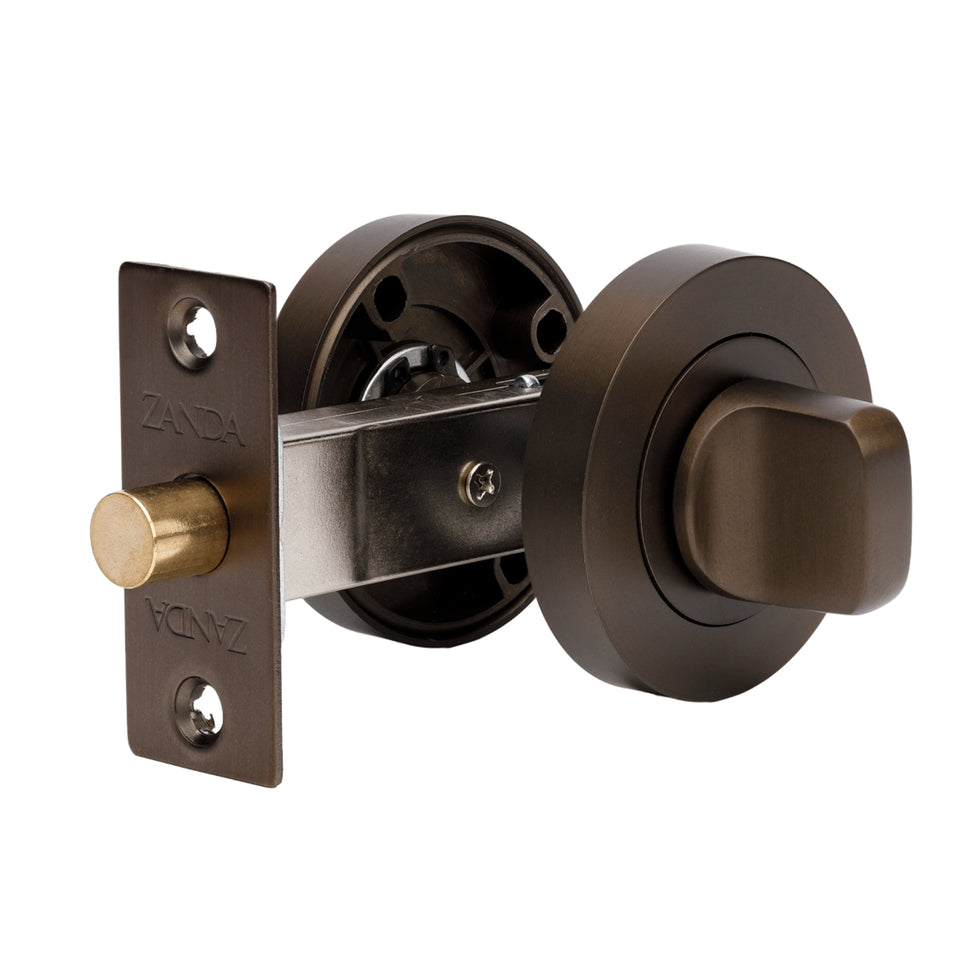
Zanda offers deadbolts in the Jura, Triad, Futura and Round Slimline ranges. The Jura suits doors 32 to 50mm thick with an adjustable 60 or 70mm backset and a C4 keyway, in single cylinder (key and snib) and double cylinder (key both sides), keyed different. The Round Slimline is a key and snib deadbolt with a 63mm face that retrofits most existing deadbolt installations, a six pin cylinder, two keys and a 60 or 70mm adjustable backset. The Triad has a 65mm diameter with a 20mm projection and three keys. See Zanda Futura slimline deadbolts for the Futura family.
Nidus Eurobolts
The Nidus Spring and Lonsdale Eurobolts are single and double cylinder locks with a 70mm backplate diameter that suits a standard 54mm cross bore. They come with a latch for quicker installation, suit doors 34 to 45mm thick with a 60mm backset and have a snib projection of 46mm on the Lonsdale. They come in graphite grey, satin brass and brushed nickel. The Nidus ATZ is a stainless steel single cylinder deadbolt with five keys.
Euro cylinders and Euro mortice locks
A Euro cylinder is a standard shaped cylinder that fits a Euro mortice lock, and a locksmith can change it without replacing the lock. The Nidus Mardeco M Series Euro cylinder is a five pin C4 cylinder, 39mm, for the 8104 Euro lock, and suits doors 47 to 58mm thick. The Zanda double turn lock kits include a Euro lock, a single cylinder and escutcheons, for doors 35 to 53mm thick with a 60mm backset. These suit pull handle doors and period entries.
Roller locks and bolts
A roller lock holds a door shut with a spring loaded roller, with a key cylinder for locking. The Zanda round and square roller lock kits include a 1140 roller lock with a 57mm backset, an escutcheon and a 70mm Euro cylinder. The Lockwood 7580 roller bolt has a matte black face plate and a T strike, with an adjustable bolt and both 30mm and 90mm strikes supplied. Roller locks suit doors with pull handles, where a lever latch would be out of place.
Bathroom and toilet door locks
Searches for locks for toilet doors and bathroom locks are looking for a privacy lock, not a key lock. A bathroom lock should be easy to work from inside and should have a release from outside for emergencies. The Iver Puerto privacy turn and the Zanda round privacy kit are inside turns. Privacy lever and knob sets have the lock built in. See privacy door levers and privacy knob sets for sets, and the Momo privacy thumb turn set for a mortice lock.
A key deadbolt on a bathroom door is not the right choice, because the person inside may not have a key. Choose a privacy lock.
Smart and digital locks
Smart and digital locks replace the daily key with a code, fingerprint, card or app. The Yale Libi, Assure, Luna Pro+, ByYou Pro and Kyra Pro and the Zanda Stealth sit in this group, and the Lockwood 001 Touch Plus upgrades an existing deadlatch. See digital door locks and electronic door hardware.
Key sash fasteners
The TradCo key operated locking sash fastener draws the two halves of a sliding sash window together and locks with a key. It has a compact 20 by 64mm profile in antique brass. It is a window fitting and sits in the collection with the locks. It suits a timber sash window that needs an extra measure of security.
Door thickness, backset and holes
Three numbers decide fit. Door thickness is the width of the door edge: 30 to 45mm for the Lockwood 001 and 355, 32 to 48mm for the 005, 32 to 45mm for Lane, 32 to 50mm for Zanda Jura and 34 to 45mm for Nidus. Backset is the distance from the door edge to the centre of the hole: 60mm, 57mm and an adjustable 60 to 70mm are common. The hole is the large round hole through the door face, usually 54mm.
Measure each on your door. When a door is thinner than a lock's range, a spacer ring may cover it, as on the Lockwood 005 and 7107.
Keyways and keys
A keyway is the shape of the key slot. C4 is a common Australian keyway, used by Lane, Zanda, Lockwood and Yale. A 3 pin key, as on the Nidus cavity entrance sets, is a different system. Habitat keys are used on the Zanda Round Slimline. If you want several locks to share a key, they must use the same keyway and be keyed alike by a locksmith.
Check the number of keys on each product page: two, three or five. Keep a spare in a safe place.
Why the strike and frame matter as much as the lock
A bolt only holds if the frame holds. The strike is the plate and box in the frame that receives the bolt. Fix it with long screws that pass through the frame into the stud behind, so a hard push on the door is carried by the structure and not by the thin timber of the door jamb. A box strike with a concealed cross grain frame strengthening screw, and the 001 deadlatch lists a door frame reinforcing strike with 11 concealed anchorage points. Those details are there because forcing a door usually fails at the frame, not at the bolt.
When you fit a lock, look at the frame behind the strike. If the timber is thin, split or rotten, repair it or add a reinforcing plate first. A strong lock in a weak frame gives only the look of security.
Deadbolts and glass
Many front doors have glass in them or beside them. Think about how a lock behaves near glass. A double cylinder needs a key on the inside, so someone who breaks a pane and reaches in cannot simply turn a knob. A single cylinder has a thumbturn that can be reached. The trade-off is how easily you can leave in an emergency, so choose with the whole household in mind, and keep a key where everyone knows but where it cannot be reached from outside.
If the glass is large, a lock position out of arm's reach of the pane helps. Ask a locksmith to look at the layout.
Rekeying and keying alike
A locksmith can rekey a cylinder so a new key works and old keys do not. This is useful when you move house, lose a key or end a tenancy. It avoids replacing the lock, and a standard cylinder such as C4 makes it simple. A locksmith can also key several C4 locks alike, so one key opens the front door, the side door and the garage.
Plan which doors share a key. A shared key is convenient, but a lost key affects every door that uses it. Many households key the main external doors alike and leave a shed or a garage on its own.
Bump and pick resistance
Some locks list resistance to bumping and picking, which are methods of opening a pin cylinder without the right key. The Lockwood 355 and the Lockwood 001 Touch Plus family list such features. A cylinder with extra security pins or a restricted keyway resists them better. Read the product page for what each lock offers, and compare like with like. No lock is unbeatable, but a better cylinder raises the effort needed.
Locking a door from the inside at night
A common routine is to lock the door from inside at night. With a single cylinder deadbolt, you turn the thumbturn. With a Zanda Jura single cylinder, you use the snib. With a double cylinder, you use the key. Whichever you use, make sure everyone in the household can open the door quickly in an emergency, and know where the key is. Practise the routine once, so it is familiar.
Matching locks to the handle set
A deadbolt works with a handle that has its own latch. The lock and the handle should agree in finish and size so the door reads as a set. A 54mm deadbolt such as the Zanda Futura matches a 54mm lever rose. A 70mm Nidus Eurobolt plate matches a 70mm Nidus backplate. A Lane deadbolt matches Lane knobs and levers. If you mix makers, compare the finish names in person, since the same name can differ.
Check also the spacing on the door between the handle and the lock, so the holes do not overlap.
Fitting a lock
Read the instructions. Mark the position on the door, drill the 54mm hole and the smaller hole in the edge, fit the bolt, the cylinder and the plates, and fit the strike and box in the frame with long screws. Test the key, the turn and the throw, and check that the bolt enters the frame cleanly. A lock needs a sound door and frame to work, so check both.
If you are not confident, ask a locksmith or a carpenter. A cut in the wrong place cannot be undone.
Common mistakes to avoid
The first mistake is using a key lock on a bathroom door. The second is expecting a deadbolt to latch the door. The third is choosing double cylinder without a key plan. The fourth is ignoring door thickness and spacer rings. The fifth is mixing keyways when keying alike. The sixth is fitting a strong lock to a weak frame.
A short list avoids all six: function, latch, cylinder, thickness, keyway and frame.
Our recommendation
For a front door, choose a Lockwood 001 deadlatch or a Lane, Zanda or Nidus deadbolt with a handle, single cylinder for easy exit or double cylinder where glass is close. For a bathroom or toilet, choose a privacy lever, knob or turn. For a pull handle door, choose a roller lock or a double turn lock kit. For key-free entry, choose a smart or digital lock.
Measure the door, choose the cylinder, plan the keys and check the frame. Then the lock will hold.
Questions about door locks and latches
What is the difference between a latch and a lock?
A latch holds the door closed and a handle withdraws it. A lock needs a key, code or turn to move a bolt.
What is a double cylinder lock?
It takes a key on both sides of the door. A single cylinder takes a key outside and a turn or snib inside.
What lock should I use on a bathroom door?
A privacy lock that you work from inside without a key, such as a privacy lever, knob or turn.
What door thickness do deadbolts suit?
It varies by model, for example Lockwood 005 32 to 48mm, Lane 32 to 45mm and Zanda Jura 32 to 50mm.
What is C4?
It is a common Australian keyway. Locks with the same keyway can be keyed alike by a locksmith.
Write down the function of every lock before you shop. A door that leads outside needs a key lock, a bathroom door needs a privacy lock that can be released from outside, and an internal hallway door needs only a latch. Match each function to the door, then check the backset and the door thickness, and buy the full set for the house together so the finish matches.

