


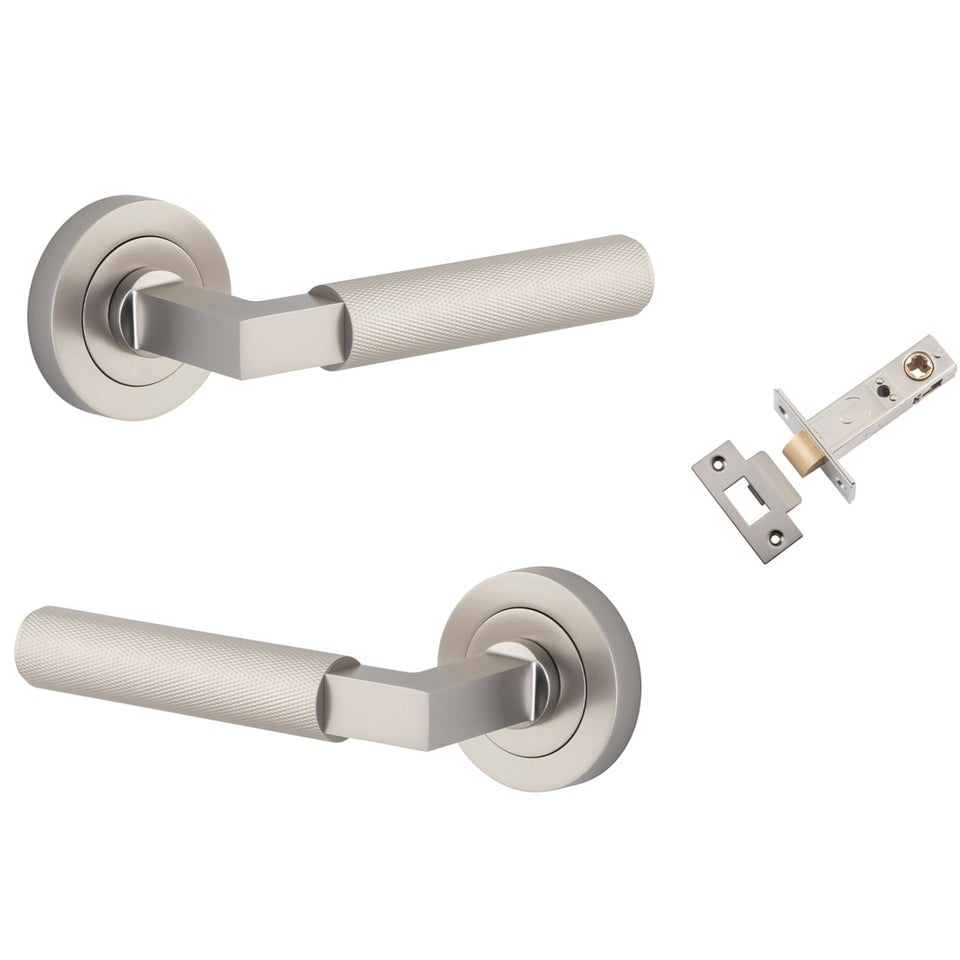
Door escutcheons and roses buying guide
A door rose is the round plate behind a lever or knob, and an escutcheon is the plate around a keyhole or cylinder. Both finish the hole in the door, cover the fixings and protect the paint. This collection holds door hardware sets built around roses, rosettes and backplates, from Lockwood, Lane, Zanda, TradCo, Iver and Nidus, and the kits with escutcheons for roller locks and entrance levers, in matte black, brushed nickel, satin brass, chrome, antique brass and more. This guide explains the difference between a rose, a rosette, a backplate and an escutcheon, what sizes the roses in the range come in, how to cover an old or oversized hole, how roses are fixed, how to match shapes and finishes and what to check before you order. For related groups, see interior door levers, passage lever sets and door knobs.
Rose, rosette, backplate and escutcheon
The words overlap, so it helps to define them. A rose is a small round plate that sits behind a lever or knob and covers the hole where the spindle passes through the door. A rosette is another word for the same thing, and Lane uses it. A backplate is a longer plate, oval, rectangular or tall, that carries the handle and often covers the keyhole as well. An escutcheon is a plate around a keyhole or a cylinder, which protects the door from key scratches and finishes the opening.
Searches for a door rose, a door rose plate, a door knob rose and a door handle rose all mean the first of these. Searches for an escutcheon or a door escutcheon plate mean the keyhole plate.
What a rose does
A rose does three jobs. It hides the raw edge of the hole, which is often rough or chipped. It carries the fixings that hold the lever or knob to the door, either as visible screws or concealed behind a trim. And it spreads the load of the handle over a wider area of the door face, so a hard pull does not mark the paint or crush the timber.
A larger rose covers more and spreads the load further. A smaller rose looks refined. The right size is the one that covers your hole with a margin.
Rose sizes in this range
The roses in the range vary. The Lockwood Velocity has a 63mm rose that fits 50mm or 54mm holes, and a square trim version with a large rose. The Lockwood Vivid has a 54mm rose. Lane uses a round rosette on a 50 to 54mm cross bore. Zanda uses a 54mm screw on rose with concealed fixing, which can be upgraded to a 65mm rose, and a 65mm rose or backplate on the Kent, can be retrofitted over existing 55mm holes. Nidus uses a 70mm backplate for a 54mm bore and a 63mm rosette for a 50mm cross bore.
The TradCo Milton knob has a 54mm round rose. The TradCo large milled edged mortice knob has a 52mm round rose. Iver offers round roses and larger backplates on its kits.
Covering an old or oversized hole
When you replace a handle, the old hole may be larger than the new rose, or it may have a rough or damaged edge. A bigger rose or a backplate hides it. The Zanda 65mm rose and backplate, the Nidus 70mm backplate and the Lockwood 63mm rose are made for that kind of retrofit. The 65mm rose can be retrofitted over existing 55mm holes.
Measure the hole before you order. Add a margin of several millimetres on each side, so the rose covers the edge. If the hole is larger than the biggest rose, a backplate is the answer.
Round, square and oval roses
Roses come in several shapes. Round is the most common and suits almost any lever or knob. Square, like the TradCo Menton square rose and the Lockwood Velocity square trim, gives a sharper, more architectural look. Oval and rectangular backplates, like the Iver Baltimore and Brunswick ovals and the Helsinki and Osaka rectangles, suit a vertical door stile and a period or contemporary style.
Choose the shape to suit the lever and the house. A round lever on a round rose is calm and traditional. A straight lever on a square rose is crisp and modern.
How roses are fixed
Roses are fixed in different ways. A screw on rose threads onto the spindle housing, so no screws show on the face. The Zanda 54mm rose is a screw on rose with concealed fixing. A concealed fixing rose has the fixings hidden under a removable trim, as on the Lockwood Velocity. A tie bolt fixing passes bolts through the door from one backplate to the other, which gives a firm fixing and a stable handle. Iver kits supply tie bolts, with face fix wood screws and tie bolts to suit 55mm doors, and extended tie bolts available separately for 90mm doors.
The fixing affects how firm the handle feels and how easy it is to tighten later. Through door bolts keep the rose square and stop it twisting.
Escutcheons on locks
An escutcheon surrounds a keyhole or a cylinder on the face of the door. The Zanda roller lock kits include round or square escutcheons, a pair for the two faces. The Zanda Vertex entrance double cylinder lever set includes a 7020.2 escutcheon and a 70mm Euro cylinder. The Momo Euro cylinder escutcheon set protects the door surface from key scratches and marks. See Momo architectural door hardware for the Momo escutcheons.
An escutcheon is worth having where a key is used often, since it protects the paint around the cylinder and gives the keyhole a finished look.
Knob roses
A knob sits on a rose too. The TradCo Milton knob has a round rose and a projection of 65mm, and the large milled edged mortice knob has a round plate, hollow sheet brass construction and a projection of 48mm. Knob roses are usually round, and the size of the rose is often similar to the knob. A knob with a small rose can look top heavy, and one with a larger rose looks settled.
Lever roses and the lever
A lever and its rose are designed together. The product page for a set gives the combination, so choose the set and do not mix parts from different makers. A lever and a rose from different makes may have different spindle lengths and fixing patterns, and may not fit. If you want to change the rose size, check whether the maker offers an upgrade, as Zanda does with the 65mm rose for the Duke.
Door thickness
The rose and the handle must suit the thickness of the door. The Lane sets suit 33 to 45mm. The Zanda Kent and Baxter suit 35 to 53mm. The TradCo knobs and levers suit 35 to 60mm, and the Iver kits suit 35 to 60mm. Measure the door at the edge and compare. A rose used on a door outside its range may leave the handle loose.
Finishes
Roses and escutcheons come in the finish of the handle: matte black, brushed nickel, satin brass, chrome, antique brass, gun metal grey and others. Match the rose to the lever or knob it supports, and to the hinges and stops. A rose in a mismatched finish stands out.
See hinges and door stops for pieces in matching finishes.
Choosing a rose for a thick or thin door
Door thickness changes how a rose sits. On a thin hollow core door, a large rose spreads the load and stops the handle crushing the skin. On a thick solid door, the fixings must reach through, and tie bolts or longer screws may be needed. The Iver kits supply tie bolts for 55mm doors and list longer tie bolts for 90mm doors. The Lane sets cover 33 to 45mm and the TradCo and Iver sets 35 to 60mm.
If the door is at either extreme, check the instructions for the fixing method. A rose that is held by short screws into a thin skin will pull out. A rose on a very thick door with short bolts will not close.
Roses on external doors
An external door faces rain, sun and dust. A rose on the outside protects the hole from water getting into the door, so a snug fit matters. Choose solid brass or stainless steel roses with a good finish, and check that the rose sits flat against the door with no gap. A gap lets water into the hole and can rot a timber door. A bead of sealant behind the rose is sometimes used on an external door, if the maker allows it.
See entrance door hardware for entrance sets with roses and backplates.
Hollow and solid roses
Some roses are solid, and some are made of hollow sheet brass. The TradCo large milled edged mortice knob is made from hollow sheet brass, with a neat edge and a round plate. Hollow construction is lighter and gives a traditional look. Solid brass, like the TradCo Milton, is heavier and more substantial in the hand. A solid rose is stiffer and resists denting.
Choose by the weight and feel you want. For a busy door, solid construction is the safer choice. For a decorative door, a hollow rose is fine.
Roses for knobs and levers in a whole house
When you fit a whole house, keep the rose style consistent. If the levers have a round rose, use round roses on the knobs and dummy levers. If they have a square rose, use square throughout. The size can vary a little by function, but the shape should agree. A mix of round and square roses on doors seen together can look unplanned.
Choose one range and finish, and order all the sets together so the roses match in shade and size.
Fitting a screw on rose
A screw on rose is fitted by threading it onto the spindle housing until it sits flat against the door. Fit the handle first, then screw the rose on, snug but not over tight. Check that the rose sits square, and that the lever returns to the horizontal. Some roses have a small locating pin, so they cannot rotate.
If the rose is loose after fitting, check that the housing is seated and the fixings are tight. If it is too tight to turn, check that the threads are clean.
Painting around roses
Paint the door before you fit the roses if you can. If the door is already painted and the rose is fitted, mask the rose before painting, or remove the handle and rose for the job. Paint on the rose can mark a plated finish. Remove paint from a rose gently with a damp cloth before it dries, and avoid solvents on lacquered or coated finishes.
Planning rose and plate sizes across a hallway
Doors in a hallway are seen together, so the roses on them form a pattern. If the doors are all the same height and style, use the same rose size on each, set at the same height, so the line of roses runs straight along the wall. Where one door has a larger backplate, such as a front door with a long plate, keep the other roses simple so the front door stays the feature.
Mark the rose height on one door and copy it to the rest with a story rod, a strip of timber marked with the height, so every handle sits in line.
Aligning the rose with the door stile
A panelled door has stiles, the vertical rails at the edges. The rose should sit centred on the stile with a margin on each side, not run onto the panel edge or the moulding. A 63mm or 70mm rose needs a stile at least a little wider than the plate. Measure the stile before you order. If the stile is narrow, a smaller rose, such as the 54mm, is the safer choice.
A long backplate suits a wide stile and a plain face. On a narrow stile or a door with raised mouldings it may foul the detail.
Checking the finish in place
A rose is seen close up, so the finish matters. Hold the set against the door in the light of the room before you commit. A satin finish looks softer in daylight and warmer under lamps. A polished finish picks up reflections. A matte finish looks the same in all lights. If you are unsure, order one set first, fit it on a door and look at it for a few days before you order the rest.
Replacing a rose
If a rose is damaged, you can often replace the whole set. Note the model name and finish on the packaging or the product page. A replacement rose alone may not be available, since the rose is part of the set. When you replace a set, measure the old hole and the old rose, and choose a new set whose rose covers the hole.
Paint any marks left by the old rose before you fit the new one, so the finish is clean.
Care
Wipe roses and escutcheons with a soft damp cloth and dry. Avoid abrasive pads and strong chemical cleaners. Dust collects at the edge of a rose, so wipe the join between the plate and the door. Check the fixings from time to time. A rose that wobbles needs its screws or bolts tightened.
Common mistakes to avoid
The first mistake is choosing a rose smaller than the hole. The second is mixing a rose from one maker with a lever from another. The third is ignoring door thickness. The fourth is forgetting that a rose is part of a set. The fifth is choosing a finish that clashes with the handle. The sixth is skipping an escutcheon on a keyed door.
A short list avoids all six: size, make, thickness, set, finish and escutcheon.
Our recommendation
Choose the handle first, and let the rose come with it. For a retrofit over an old hole, choose a set with a 63mm, 65mm or 70mm rose or a backplate. For a clean, modern look, choose a round or square rose in a matching finish. For a keyed door, choose a set with an escutcheon or add one.
Measure the hole, check the thickness and match the finish. Then the rose will cover the hole and finish the handle.
Questions about door escutcheons and roses
What is a door rose?
It is the round plate behind a lever or knob that covers the hole and the fixings.
What is an escutcheon?
It is a plate around a keyhole or cylinder that protects the door from key scratches.
What size roses do these sets have?
They include 54mm, 63mm, 65mm and 70mm roses and backplates, depending on the range.
Can a rose cover an old hole?
A larger rose or a backplate can. The 65mm rose can be retrofitted over existing 55mm holes.
Can I buy a rose separately?
A rose is usually part of a handle set. Check the product page for the set you need.

