


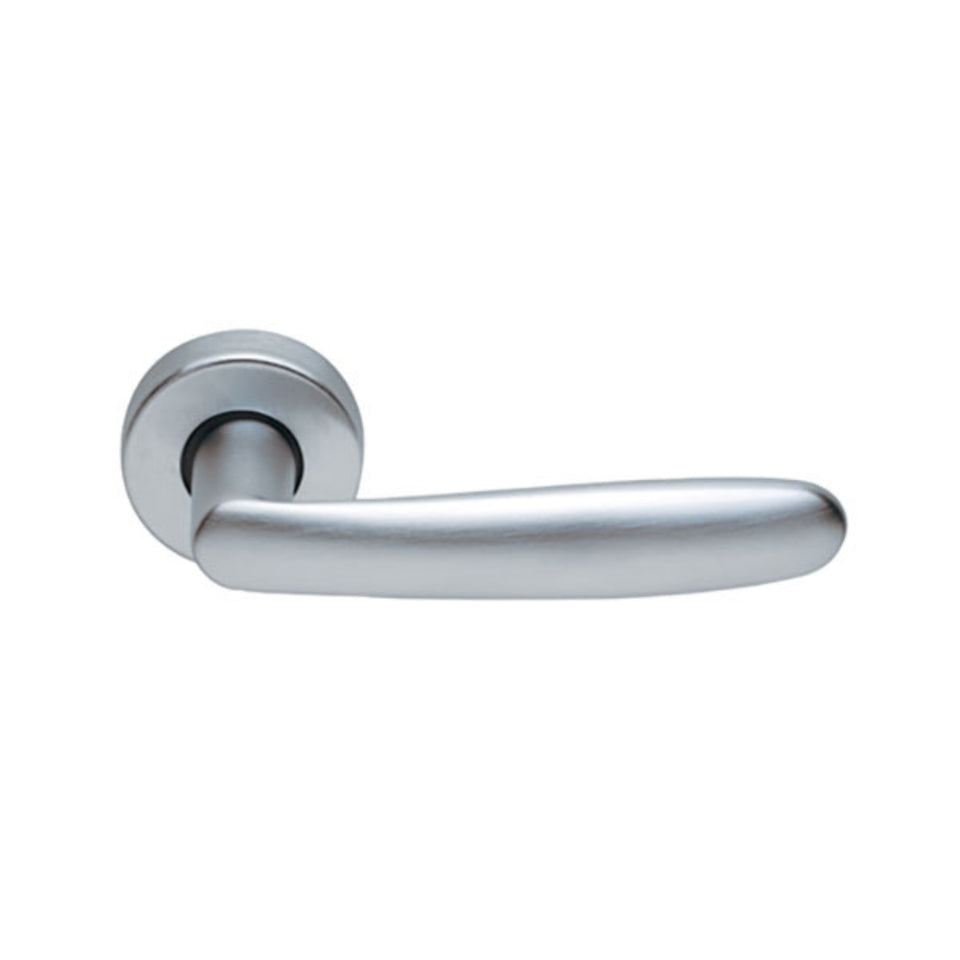
Interior door levers buying guide
An interior door lever is the handle you press down to open a door inside the house. It comes in three functions: passage, which latches and does not lock; privacy, which locks from inside; and dummy, which does not turn. This collection holds interior lever sets from Lane, Lockwood, Zanda and Nidus, in matte black, brushed satin chrome, chrome, gun metal grey, satin brass, brushed nickel and graphite grey, on round roses of 54mm to 65mm. This guide goes room by room, because the right lever depends on the room: which function a bedroom, a bathroom, a living area and a cupboard each need, which range suits which house, how to read the fit numbers on a product page and how to order for a whole house. For the wider lever range, see door levers and interior door handles.
Bedroom door levers
Most bedroom doors take a passage lever, which latches the door shut and lets anyone in. If you want the option to lock the door, a privacy lever adds an inside lock. A master bedroom or a teenager's room often takes privacy. A child's room or a guest room often takes passage, so a young child cannot lock themselves in.
A bedroom is a quiet room, so the lever should close softly and feel good in the hand. Choose a finish that suits the room. Matte black suits a modern bedroom. Satin brass suits a warm one. Brushed satin chrome suits a neutral one. Check the latch and strike alignment after fitting, since a rattle at the strike is a nuisance when you are trying to sleep.
Bathroom, ensuite and toilet levers
A bathroom door takes a privacy lever, which latches the door and locks from the inside without a key. The same applies to an ensuite and a toilet. The lock control sits on the inside rose, and the outside lever turns only when the lock is off.
A bathroom is a damp room, so choose a finish that wipes clean and resists moisture, and wipe off splashes. Match the finish to the tapware and the towel rail, so the room looks planned. Make sure everyone in the household knows how to open the door from outside if they ever need to. See privacy door levers for the full privacy range.
Living areas, hallways and laundries
Doors between living areas, hallways, kitchens and laundries take passage levers. They latch the door to keep out draughts or sound and never lock. Choose a lever with a comfortable grip, since these doors are used all day. A lever with a longer arm gives more leverage and suits people with limited grip.
Because these doors are on show, the lever is a visible design choice. A round rose is neat and modern. See passage door handles and passage lever sets for more.
Cupboards, pantries and wardrobes
A cupboard, pantry or wardrobe door that closes with a catch takes a dummy lever, which is a fixed lever that does not turn. It gives the door a handle in the same design as the lever sets around it. The Lane and Zanda dummy levers are sold as single levers, so order two if you want one on each face of the door. See dummy levers for the dummy range.
Lane lever ranges
Lane offers interior levers in the Avalon, Buckingham, Cambridge, Murano, Oxford, Tovetto, Victoria and Westminster ranges and the PIVYT, in brushed satin chrome, matte black and gun metal grey. The product pages suit doors 33 to 45mm thick and a 50 to 54mm cross bore, and the passage and privacy sets use a 60mm backset latch. The pack holds two lever sets, a latch, a striker plate and all fixings. The Victoria is offered in left hand and right hand versions, and the Tovetto has a 65mm lever length.
Each range has its own lever shape, from slim to curved. Look at the images on the product pages and choose the shape that suits your doors. See Lane for the brand.
Lockwood Velocity and Vivid
The Lockwood Velocity series has six lever designs, the Summit, Spire, Element, Glide, Hakea and Saltbush, on a 63mm round rose that fits 50mm or 54mm holes, so it suits both retrofit and common door preparations. The lever has a twist and tighten fixing action and a pre-assembled lever set for quick installation, with all fixings concealed beneath a removable rose trim. The Vivid series offers four lever designs on a 54mm rose that suits doors up to 45mm thick.
The Velocity is a practical choice when you are fitting many doors, because it is quick to fit. See Lockwood for more.
Zanda lever ranges
Zanda offers interior levers in the Boston, Duke, Epic, Futura, Oxford, Vienna and Zurich ranges. It has a 60mm backset and a 54mm screw on rose with concealed fixing. You can upgrade to a 65mm rose if you need a larger one. Finishes include matte black, brushed nickel, chrome plated and satin brass. See Zanda door hardware for the range.
Nidus levers
The Nidus Knurled Domici is a passage lever in graphite grey with a knurled texture on the handle, on a 63mm rosette that suits a 50mm cross bore hole. The knurled surface gives a firm grip. See Nidus door hardware for the rest of the range.
Reading the fit numbers
A few numbers decide fit. Door thickness is the width of the door edge: Lane lists 33 to 45mm and Lockwood Vivid up to 45mm. Cross bore is the large round hole through the door face: Lane suits 50 to 54mm, and the Lockwood Velocity rose covers 50 or 54mm holes. Backset is the distance from the door edge to the centre of the hole: Lane and Zanda list 60mm. Rose size is the diameter of the plate: 54mm, 63mm, 65mm.
Measure these on your doors before you order. A set whose numbers match drops in.
Rose size and covering the hole
The rose must cover the hole. A 54mm rose covers a standard 54mm hole neatly. A 63mm or 65mm rose covers a 50mm or 54mm hole and any damage at the edge, which helps when you replace an old lever. If the old hole is larger than the new rose, choose a set with a bigger rose or a backplate.
Left hand, right hand and non-handed
A lever points one way. Some are made for a left hand or right hand door, and some are non-handed and rotate to suit either. The Lane Victoria dummy is offered in left and right hand versions. Many sets are non-handed. Check the product page, and for a handed lever, check the swing of each door.
Finishes
The finishes include matte black, brushed satin chrome, chrome, gun metal grey, satin brass, brushed nickel and graphite grey. Choose the finish to match the hinges, stops and cabinet handles in the room. A consistent finish through the house makes the doors look like a set. See hinges and door stops for pieces in matching finishes.
Lever shape, length and grip
A lever can be slim and straight, curved, squared or textured, and the shape decides how it feels. A longer lever gives more leverage, which helps anyone with a weak grip. A shorter lever looks neat on a small door. The Lane Tovetto lists a 65mm lever length, which is short, and other ranges are longer. Hold a lever of similar size if you can, or compare the images and the dimensions on the product page.
Think about the hand that will use it every day. A child needs a lever that is easy to press. An older person needs one that is easy to grip and does not need a twist. A round rose and a straight lever are easy for most hands.
Choosing by the era of the house
The style of the house guides the choice. A Federation or Victorian house suits a lever with some curve and a warm finish such as satin brass or brushed nickel. A mid century house suits a slim, straight lever in chrome or brushed satin chrome. A contemporary house suits a squared or knurled lever in matte black or graphite grey. A coastal house suits a clean lever in brushed nickel or satin chrome.
Look at the other hardware in the house, such as the windows, the front door set and the cabinet handles. The interior levers should agree with them.
Mixing ranges and finishes
You can use different ranges in different parts of a house, but keep the finish constant. A Lane Oxford in matte black in the hall and a Zanda Epic in matte black in the bedrooms look related, even if the lever shapes differ. A strong change of finish between rooms can look unplanned. If the house is open plan, keep a single range in the areas that are seen together.
Sound, draughts and the latch
The latch inside a lever set does the work of holding the door shut. A good latch springs back cleanly and meets the strike without a bang. Fit the strike plate carefully, because a plate set slightly off will make the door rattle. In a bedroom or study, a quiet close matters. If the door rattles, check that the door sits square in the frame and that the hinges are tight.
A door that closes firmly also keeps out draughts and sound, which matters between a living area and a bedroom.
Replacing existing levers
Remove an old lever and check the door. Measure the cross bore, the edge hole, the backset and the thickness. Compare these with the new set. Most Australian interior doors take a 54mm hole and a 60mm backset, which is why so many sets list those figures. If the old rose was larger than the new one, choose a set with a 63mm or 65mm rose to cover the marks.
If the old lever was a different make, you can replace the whole set, lever, spindle and latch, in one go. Mixing parts from different makers can leave the spindle too short or too long.
Children's rooms and safety
A privacy lever in a child's room can lock a child in or an adult out. For young children, a passage lever is the safer choice, so the door can always be opened from either side. If you do fit a privacy set, know how it releases from outside and keep that method in mind. Teach older children how the lock works and how to open it.
Lockwood Velocity and a whole house
The Velocity range is made to go in quickly. The lever set arrives pre-assembled, and a twist and tighten action fixes it, with the fixings hidden beneath the rose trim. In a house with many doors, that saves time. Because it fits 50mm or 54mm holes, it suits most standard preparations and many retrofits. Choose one of the six lever designs and one of the finishes, and use it throughout.
When a lever stops working
If a lever feels loose, tighten the fixing. If it does not spring back, the spring in the latch or the lever may be worn, and replacing the set is the usual cure. If the door will not latch, check the strike. If a privacy lock will not release, check the inside control and the latch for a jam. Most faults are simple to fix once you can see which part has failed.
Keep the packaging and the instruction sheet with the house records, so you have the model name and finish when you need a spare.
A sample schedule for a four-bedroom house
To see how the pieces add up, picture a four-bedroom family home. The main bedroom, the ensuite, the family bathroom, the separate toilet and a home office take privacy levers, so five privacy sets. The three other bedrooms, the hallway, the living room, the kitchen, the laundry and the study nook take passage levers, so eight passage sets. The linen cupboard, the pantry and the walk-in robe take dummy levers, one or two for each, depending on how the door is used.
Add the totals, order in one finish and check a sample of doors for thickness. That plan gives a house with one lever design throughout, which looks consistent and is easy to maintain.
Ordering for a whole house
Walk through the house and list every interior door with its function. Count the passage, privacy and dummy sets. Check the thickness and hole of a sample of doors from each room. Choose one range and one finish, and order all the sets together, so the shade and shape match. Add spare strike plates if the product page does not include them.
If the house has doors of different thicknesses, choose ranges whose limits cover them all.
Fitting an interior lever
Fit the latch into the door edge, with the angled face towards the closing direction. Pass the spindle through and fit the levers and roses on each side. For a privacy set, fit the lock control on the inside. Fix the roses, tighten evenly and test the lever. Fit the striker plate on the frame and check that the latch meets it cleanly.
The Lockwood Velocity can be assembled with a twist and tighten action, which is quick. Follow the instructions for your model.
Caring for levers
Wipe with a soft damp cloth and dry. Avoid abrasive pads and strong chemical cleaners. Check the fixings from time to time, since a lever that loosens will wear the spindle. If a lever sags, check the spring and the fixing before replacing the set.
Common mistakes to avoid
The first mistake is using passage on a bathroom. The second is ordering one dummy lever where two are needed. The third is ignoring thickness and hole size. The fourth is forgetting the handing on a handed lever. The fifth is mixing finishes through the house. The sixth is overlooking the latch and strike.
A short list avoids all six: function, count, size, handing, finish and latch.
Our recommendation
For a modern house with many doors, choose the Lockwood Velocity in the finish that suits the house. For a plain, neutral look, choose a Lane range in brushed satin chrome. For a house with warm metals, choose a Zanda range in satin brass. Order passage for the hall and living areas, privacy for the bathrooms and bedrooms that lock and dummy for cupboards.
List every door, check the numbers and keep one finish. Then the levers will fit and match through the house.
Questions about interior door levers
What lever do I need for a bedroom door?
Usually a passage lever, or a privacy lever if you want to lock it.
What lever locks a bathroom door?
A privacy lever, which locks from the inside without a key.
What door thickness do the Lane levers suit?
It suits doors 33 to 45mm thick, with a 50 to 54mm cross bore and a 60mm backset latch.
What is a dummy lever?
It is a fixed lever that does not turn, used on cupboards and wardrobes.
Do the sets include a latch?
The Lane passage and privacy packs include a latch and striker plate. Check each product page for your model.

