


Shower Arms
97 Items
-

Sold out Caroma Titan Stainless Steel Wall Shower Arm
Checking delivery...$133$0 (-0%) offRRP of $133 -

Sold out Caroma Titan Stainless Steel Ceiling Arm - 200mm
Checking delivery...$135$0 (-0%) offRRP of $135 -

Sold out Caroma Luna Straight Arm 210mm Chrome
Checking delivery...$156$0 (-0%) offRRP of $156 -
In Stock

Sold out Caroma Luna Right Angle Shower Arm 320mm
Checking delivery...$156$0 (-0%) offRRP of $156 -

Sold out Nero Round Shower Arm 330m Length Brushed Nickel
Checking delivery...$135$0 (-0%) offRRP of $135 -

Sale On Now!
Up to 70% off across the store, plus free towels and mirrors up for grabs on orders over $800*
-

Sold out Nero Round Shower Arm 330m Length Gun Metal
Checking delivery...$161$0 (-0%) offRRP of $161 -

Sold out Nero Square Shower Arm Brushed Nickel
Checking delivery...$172$0 (-0%) offRRP of $172 -

Sold out Nero Square Swivel Arm Chrome
Checking delivery...$269$0 (-0%) offRRP of $269 -

Sold out Nero Square Swivel Arm Matte Black
Checking delivery...$309$0 (-0%) offRRP of $309 -
-

Sold out Nero Square Swivel Arm Gun Metal
Checking delivery...$471$0 (-0%) offRRP of $471 -

Sold out Caroma Luna Right Angle Shower Arm Satin Black
Checking delivery...$166$0 (-0%) offRRP of $166 -
In Stock

Sold out Caroma Luna Right Angle Shower Arm Brushed Nickel
Checking delivery...$166$0 (-0%) offRRP of $166 -
In Stock

Sold out Caroma Luna Right Angle Shower Arm Brushed Brass
Checking delivery...$166$0 (-0%) offRRP of $166 -
In Stock

Sold out Caroma Luna Straight Arm 210mm Black
Checking delivery...$166$0 (-0%) offRRP of $166 -
-
In Stock

Sold out Caroma Luna Straight Arm 210mm Brushed Nickel
Checking delivery...$166$0 (-0%) offRRP of $166 -
In Stock

Sold out Caroma Luna Straight Arm 210mm Brushed Brass
Checking delivery...$166$0 (-0%) offRRP of $166 -
In Stock

Sold out Caroma 415mm Right Angled Shower Arm - Chrome
Checking delivery...$176$0 (-0%) offRRP of $176 -
In Stock

Sold out Caroma 415mm Right Angled Shower Arm - Matte Black
Checking delivery...$194$0 (-0%) offRRP of $194 -
In Stock

Sold out Caroma 415mm Right Angled Shower Arm - Brushed Nickel
Checking delivery...$229$0 (-0%) offRRP of $229 -

Sold out Caroma 415mm Right Angled Shower Arm - Brushed Brass
Checking delivery...$229$0 (-0%) offRRP of $229 -

Sold out Caroma 415mm Right Angled Shower Arm - Gunmetal
Checking delivery...$229$0 (-0%) offRRP of $229 -
In Stock

Sold out Caroma 300mm Ceiling Shower Arm - Chrome
Checking delivery...$151$0 (-0%) offRRP of $151 -
In Stock

Sold out Caroma 300mm Ceiling Shower Arm - Matte Black
Checking delivery...$166$0 (-0%) offRRP of $166 -
-

Sold out Caroma 300mm Ceiling Shower Arm - Brushed Nickel
Checking delivery...$196$0 (-0%) offRRP of $196 -
In Stock

Sold out Caroma 300mm Ceiling Shower Arm - Brushed Brass
Checking delivery...$196$0 (-0%) offRRP of $196 -
In Stock

Sold out Caroma 300mm Ceiling Shower Arm - Gunmetal
Checking delivery...$196$0 (-0%) offRRP of $196 -
In Stock

Sold out Caroma 460mm Upswept Shower Arm - Chrome
Checking delivery...$163$0 (-0%) offRRP of $163 -
In Stock

Sold out Caroma 460mm Upswept Shower Arm - Matte Black
Checking delivery...$180$0 (-0%) offRRP of $180 -

Sold out Caroma 460mm Upswept Shower Arm - Brushed Nickel
Checking delivery...$212$0 (-0%) offRRP of $212 -
In Stock

Sold out Caroma 460mm Upswept Shower Arm - Brushed Brass
Checking delivery...$212$0 (-0%) offRRP of $212 -

Sold out Caroma 460mm Upswept Shower Arm - Gunmetal
Checking delivery...$212$0 (-0%) offRRP of $212 -

Sold out Caroma Luna Straight Arm 410mm Brushed Brass
Checking delivery...$273$0 (-0%) offRRP of $273 -
In Stock

Sold out Caroma Luna Straight Arm 410mm Brushed Nickel
Checking delivery...$273$0 (-0%) offRRP of $273 -

Sold out Caroma Luna Straight Arm 410mm Black
Checking delivery...$273$0 (-0%) offRRP of $273 -
Lifetime Warranty

Sold out Meir Round Wall Shower Arm 400mm Matte Black
Checking delivery...$236$0 (-0%) offRRP of $236 -


What a shower arm does
A shower arm is the pipe that connects a shower head to the water supply in the wall or ceiling. It extends out of the wall and lets you raise or lower the head. It also sets how far the head sits from the wall, so the arm decides two things you notice every day: the height of the spray and the distance from the tiles.
Shower arm, arm extension, extender, shower pipe, gooseneck, dropper and, for a ceiling mount, ceiling arm all describe the same part. The range covers all of them. The arms here come from several makers, in wall and ceiling versions, and most are sold as the arm only, so the head is a separate purchase. If you want the head and the arm together, see shower heads with arm. For the heads themselves, see shower roses and rain showers.
Wall arm or ceiling arm
A wall arm comes out of the wall and holds the head in front of you. Wall-mount arms keep the head close to the wall, which saves space, and they are generally better for compact showers. Wall arms are commonly used with overhead showers.
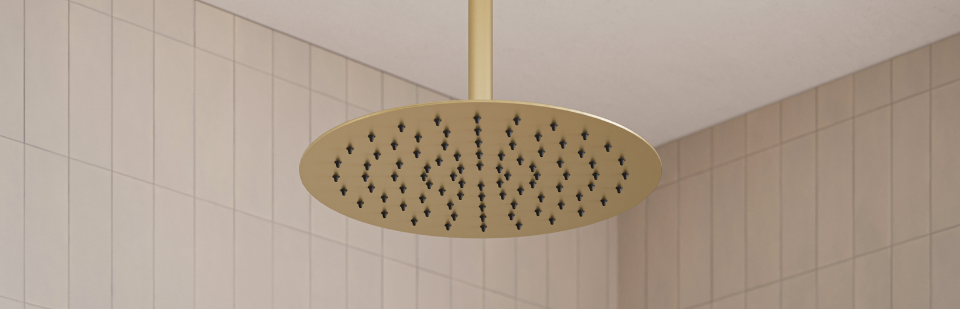
A ceiling arm drops from the ceiling and puts the head directly overhead. Ceiling arms suit rounded or rose heads, create an overhead rainfall effect and give a clean, minimalist look. They take more vertical space, need access above the ceiling and are planned during a renovation, and in a compact shower they make sense if the ceiling is high.
The call is simple. If the ceiling is closed and you want to keep it that way, use a wall arm. If the ceiling is open at framing stage and you want a true overhead drop, use a ceiling arm. For the whole ceiling-mounted picture, see ceiling showers.
The shapes of arm
Arms come in a few shapes, and each solves a different problem.
- A standard arm has a small extension and an angle. It is the usual choice for a fixed head on a wall.
- A straight arm leaves the wall level and holds the head at 90 degrees, which suits a rainfall head. It is the fix when the wall outlet is already too high.
- A gooseneck or S-shaped arm rises as it leaves the wall, which lifts the head. It is the fix when the wall outlet is too low.
- An upswept arm adds height in a single clean curve. The Caroma Urbane II upswept arm is 460 mm, and the Fienza round fixed gooseneck is a stylish upswept arm designed to increase height in the shower space.
- A right angle arm leaves the wall straight and turns at the end. The Caroma Urbane II right angled arm is 415 mm, and the Clark right angled wall arm is 400 mm.
- A swivel arm moves left and right. The Nero square swivel arm turns through 180 degrees and has a 350 mm projection from the wall and a 316 mm height.
- An adjustable arm, with a ball joint or an extension rod, changes the projection and angle after installation.
The first step with any arm is to find the height of the wall outlet. If the outlet is too high, choose a straight arm with a rainfall head, and if it is too low, choose a gooseneck. S-shaped and gooseneck arms add vertical rise when the wall fitting is too low.
How long should the arm be?
Arm length sets the projection, which is how far the head sits from the wall. Wall arms run 250 to 400 mm, and a standard arm is 400 mm. The range here runs from short droppers to long arms. The Caroma Luna straight ceiling arm is a 210 mm drop, and the Clark and Caroma Titan ceiling arms are 200 mm. The Phoenix Vivid and Lexi ceiling arms come in 300 mm and 450 mm. Wall arms come in 350, 400, 415, 460 and 500 mm, and a 600 mm extended dropper exists for taller ceilings.
Height comes next. The outlet of a fixed head sits at 2000 to 2100 mm above the finished floor, and 2100 to 2200 mm for a tall household. A rain head on a ceiling arm sits at 2100 to 2200 mm, depending on the ceiling, with at least 20 cm between a rain head and the user's head. Subtract the arm's drop from the ceiling height to see where the head will land, and confirm the figure at rough-in, before tiling.
Will the arm carry the head?
The wall arms here are brass or stainless steel, and the Meir round wall arm is brass with an electroplated finish and a half inch female thread at the wall. The Nero Zen arm is 316L stainless steel in a 400 mm length, and the Caroma Titan arm is 304 grade stainless steel. If the head is a large, heavy metal rose, choose a metal arm with a flange and fix it into solid backing.
Threads and fit
The thread is what makes an arm and a head fit. These arms have a female half inch thread at the wall, and a male thread at the head end. Most arms use a universal thread that fits Australian plumbing fittings, and most arms and heads share a standard thread so they are interchangeable across makers. Some proprietary designs and older plumbing use different threads, so check the specification of both parts.
Seal the threaded joints with thread seal tape. Remove the old tape first, wrap new tape clockwise, tighten with a wrench and avoid over-tightening. Check for leaks after the water is back on.
Extending the arm you have
Many searches are for an extension, not a new arm: a way to bring the head out from the wall or up to a better height. There are three routes, and they suit different problems. A longer replacement arm moves the head further out. An upswept or gooseneck arm raises it. An adjustable arm with a ball joint, or an extension rod, changes the projection and the angle after installation, which suits a shower that several people use at different heights.
Are shower arms a standard size?
Partly. The thread is standard, so most heads fit most arms. The length, the drop, the reach and the plate are not standard, and they vary by maker and range. A Phoenix Vivid arm and a Meir arm may both screw into the same wall fitting, but their flanges and lengths differ, so the look will not match unless you choose from one range. For brand collections of arms, see Phoenix shower arms, Caroma shower arms, Nero Tapware shower arms, and Clark shower arms.
What is in the box
- The Phoenix Vivid and Lexi arms: the arm only, so the rose is a separate purchase.
- The Clark ceiling and wall arms: the arm only, with the shower head sold separately.
- The Caroma Luna and Urbane II arms: the arm, and for the Luna, a fixing kit.
- The Meir round wall and ceiling arms: the arm and installation instructions.
- The Nero square swivel arm: the arm. The Nero Zen arm: the arm and a plate.
- The Fienza gooseneck arm: the arm with a flange included.
Brass, stainless steel and coastal arms
The material decides how the arm stands up to the bathroom. Brass is the common choice. The Phoenix Vivid arms are solid brass, the Caroma Urbane II arm has a durable brass body and the Meir arms are brass with an electroplated finish. Stainless steel is the alternative. The Caroma Titan arm is 304 grade stainless steel, which is corrosion and rust resistant and suits harsh environments. The Fienza gooseneck is stainless steel, and the Nero Zen arm is 316L stainless steel, which is marine grade and ultra corrosion resistant.
Finishes and care
Arms come in chrome, matte black, brushed nickel, brushed gold, brushed brass, gunmetal and bronze. Match the arm to the head and the tapware. Curved chrome suits traditional bathrooms, a black right angle arm gives a bold look, and brushed nickel suits a modern one. The simplest rule is to match the arm to the head, so the two read as one piece. For finish-led browsing, see chrome showers, black showers, brushed nickel showers, brushed brass showers, gunmetal showers and bronze showers.
For care, use mild detergent or soap and water, and keep cream cleaners, bleach and abrasive pads away from the finish. In hard water areas, wipe the arm and dry it after use.
Can you replace a shower arm yourself?
A like-for-like swap on an existing arm is a simple job: unscrew the old arm, clean the threads, tape the new one and tighten. Two cautions apply. Arms are removable, but a licensed, registered tradesperson should install them, and anything beyond a like-for-like swap should involve a licensed plumber. Rules on what an owner may do themselves differ by state, so ask a plumber if you are unsure. If the arm changes the outlet position, or you want a ceiling arm, a plumber is the answer.
Check the angle before the last turn. A wall arm should leave the wall level or rise slightly, and the head should face the user, not the ceiling. If the head points too high or too low, a small adjustment at the head swivel is easier than re-seating the arm.
How to choose a shower arm
- Decide wall or ceiling, based on whether the ceiling is open.
- Find the height of the wall outlet, and choose a straight, standard or gooseneck shape to land the head at the right height.
- Pick the length from the head: more projection for a rain head, a short arm for a small fixed head.
- Check the weight of the head against the arm, and add a support if the arm is long.
- Check the thread and the box for the flange, the plate and the fixings.
- Match the finish to the head and the tapware.
- Ask a licensed plumber if the outlet or the ceiling changes.
The height of the wall outlet and the length of the arm decide where the head ends up, so measure both before you look at shape or finish.

