


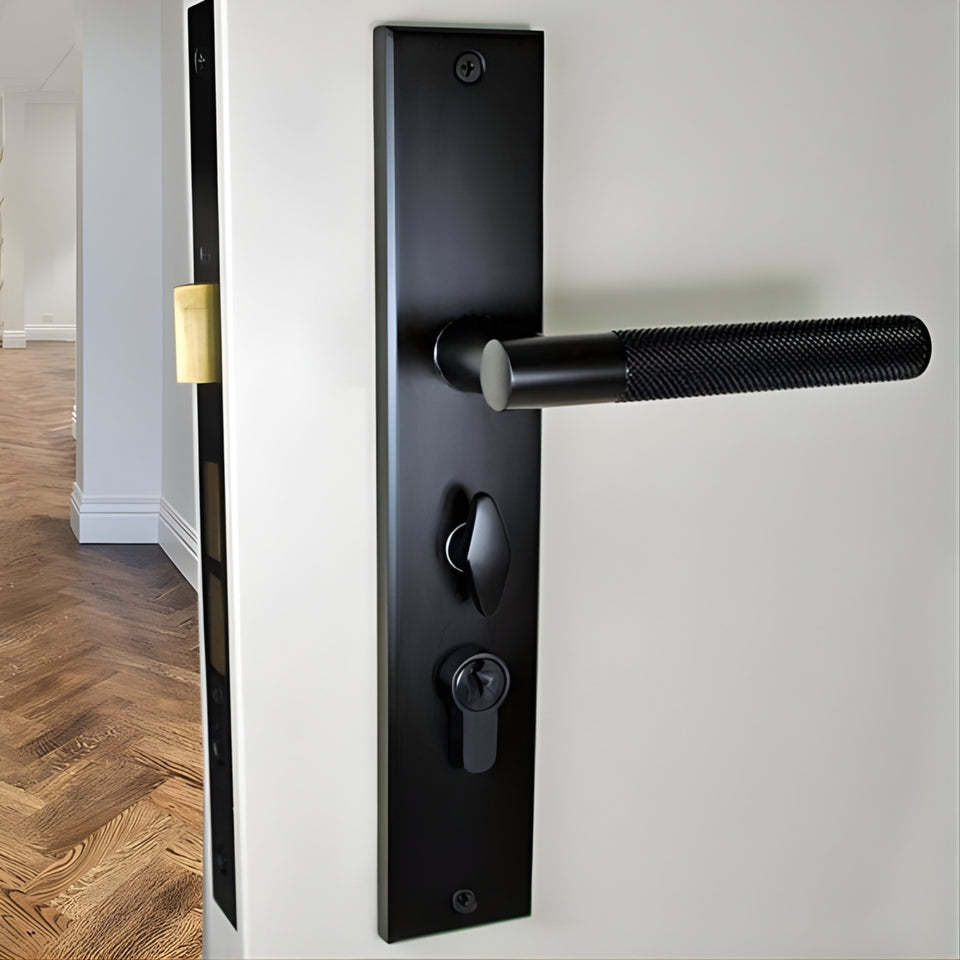
Entrance door hardware buying guide
Entrance door hardware is everything that opens, closes and secures the door to the outside: the handle you grip, the lock you turn, the hinges that carry the door and the stop that protects the wall. This collection is the wide view. It holds entrance sets in lever, knob and pull styles, deadbolts, deadlatches, roller locks, smart locks, hinges and stops from Iver, TradCo, Zanda, Lockwood, Lane, Nidus, Momo and Yale, in solid brass, stainless steel and zinc alloy. This guide helps you choose. This guide covers the parts of an entrance door, the difference between a lever set, a knob set and a pull handle, the lock types and what they mean, which door measurements decide fit, how keys and keying work, how to layer security and how to match the hardware. For each group in depth, see entry door lock sets, exterior door levers, exterior door knobs and entrance pull sets.
The parts of an entrance door
An entrance door has five jobs, and each has a part. The hinges carry the door. The handle lets you pull or push it. The latch holds it closed. The lock or bolt secures it. The stop keeps it off the wall. Some parts combine: an entrance lever set puts the handle, latch and lock in one unit, and a smart lever adds electronics.
The simplest way to choose is to decide the handle style first, then the lock, then the rest. The sections below follow that order.
Lever, knob or pull
A lever is pressed down to open the door. It is easy to use with a full hand and suits most households. A knob is turned. It is compact and traditional and suits period houses. A pull is a fixed bar you grip and pull, with the latch worked by a thumb piece, a separate lever inside or a lock alone. It suits tall, wide or pivot doors and modern houses.
Think about who uses the door. If anyone in the household has limited grip, a lever is easier. If the door is tall and wide, a long pull balances it. If the house is a Federation cottage, a knob on a backplate looks right. See exterior door levers, exterior door knobs and pull handles.
Entrance lever sets
An entrance lever set includes two levers, a latch and a lock with a key. The Lockwood Nexion L3 is a mechanical double cylinder entrance lock with levers and backplates in zinc alloy. It has a 60mm standard backset, with a 70mm latch available as an accessory, a 13mm projection brass bolt and a door thickness range of 35 to 45mm. The box holds two levers with backplates, a box strike with a concealed cross grain frame strengthening screw and two keys.
The Iver and TradCo entrance kits, in solid brass on oval, rectangular and long backplates, use a Euro mortice lock. The spacing is 85mm centre to centre, the door range is 35 to 60mm and the backset is 57 or 60mm, with two or three keys. The Lane Bala entrance and security knob sets use a C4 five pin cylinder for doors 32 to 45mm thick.
Entrance knob sets
A knob set is the traditional entrance choice. The Lane Bala knob has a C4 five pin cylinder and three keys, and the security version adds a deadbolt. The Zanda Cyclo has a 65mm backplate, an adjustable 60 to 70mm backset and a C4 keyway. The TradCo Bungalow and Milton and the Iver Cambridge are period style knobs with a Euro mortice lock. See exterior door knobs for the detail.
Entrance pull handles
A pull handle gives a long, clear grip. The Zanda round pull comes in 600mm with 400mm centres and 900mm with 700mm centres, with a 76mm projection. The Zanda Polo comes from 300mm to 1800mm. The Nidus ATZ and the Lockwood Paradigm are pull sets with a lock. A pull handle does not lock the door, so it needs a lock kit, a roller lock or a set with the lock built in. See entrance pull sets for sets with locks.
Lock types explained
The lock is the heart of an entrance door, and there are several kinds.
A deadbolt throws a solid bolt that does not retract when pushed. It locks the door but does not latch it, so you need a handle with a latch as well. The Zanda Triad, Jura and Futura, the Lockwood 005, the Lane and the Nidus Eurobolts are deadbolts. A deadlatch is a latch that locks itself when the door closes, so a card cannot slip it. The Lockwood 001 double cylinder deadlatch comes in knob and lever forms with an open in strike and suits doors 30 to 45mm thick with a 60mm backset. A Euro mortice lock sits in a pocket in the door edge and takes a Euro cylinder, which a locksmith can change without replacing the lock. A roller lock holds a pull handle door with a spring loaded roller, such as the Zanda roller lock kit with a 57mm backset and a 70mm Euro cylinder.
Single and double cylinder
A single cylinder lock takes a key on the outside and a turn or thumbturn on the inside. A double cylinder takes a key on both sides. Single cylinder lets you leave quickly in an emergency. Double cylinder is harder to open through a broken pane, but needs a key to get out. The Lockwood Nexion L3 is a double cylinder entrance lock. The Lane Bala is C4 five pin. Choose by how the door sits next to glass and how the household moves.
Smart and digital options
A smart or digital lock replaces the daily key with a code, a fingerprint, a card or a phone. The Zanda Stealth, the Yale Unity, Libi, Assure, Luna Pro+, ByYou Pro and Kyra Pro are in the wider range. Most keep a mechanical key as a backup. See digital and smart entrance sets and smart door locks for the options.
Door thickness, backset and holes
Three measurements decide fit. Door thickness is the width of the door edge: Lane 32 to 45mm, Lockwood Nexion 35 to 45mm, Iver and TradCo 35 to 60mm, Zanda Stealth 35 to 55mm. Backset is the distance from the door edge to the centre of the hole: 57mm, 60mm and 70mm are common. The hole is the large round hole through the door face, usually 54mm.
Measure each on your door before you order. When you replace a lock, remove the old one and compare. A set whose numbers match drops in.
Keys and keying
Each lock comes with its own number of keys. The Lane Bala has three, the Lockwood Nexion two, the Zanda Jura three and the Iver kits two. If you have more than one external door, ask a locksmith about keying them alike so one key opens all. Locks supplied keyed different will not match. Plan this before you order.
Keep a spare key where you can reach it if you are locked out, but not under a mat or in a plant pot.
Layers of security
A good entrance combines layers. A solid door and a sound frame come first. Strong hinges, ideally fixed pin on an external door, come next. A lock with a deadbolt or deadlatch adds a second point. A strike plate fixed into the frame with long screws completes the set. Lighting and a clear view from the street add to it.
A box strike with a concealed cross grain frame strengthening screw, which is the kind of detail that makes a strike harder to kick out. A strong lock in a weak frame does not make a secure door. See hinges for hinges that suit an entrance door.
Hinges and stops
An entrance door is heavy, so choose hinges for the weight. Use three hinges at least, and four for a tall solid door. A fixed pin hinge cannot be separated from outside, which suits an external door. A bearing hinge reduces wear on a busy door. A door stop protects the wall and the handle. See door stops for stops in a range of finishes.
Choosing for a rental or a shared home
A rental or shared home benefits from a lock that is easy to rekey or change. A deadbolt with a standard cylinder can be rekeyed by a locksmith. A smart lock with codes lets you give and cancel access without cutting keys. Check with the owner before you change a lock.
Security screen doors and flyscreens
Many entrances have a security screen door in front of the main door. The screen door has its own lock, and the main door has its own set. Choose locks that work together and do not clash in finish. A smart or digital lock on the main door and a keyed lock on the screen door is a common pairing. See screen door locks for the screen door side.
Our recommendation
Decide the handle style by the door and the house, then the lock by how you want to use it. For most homes, an entrance lever or knob set with a deadbolt gives a reliable, familiar entrance. For a tall or modern door, a long pull with a roller or smart lock gives a clean look. For key-free living, choose a smart or digital lock with a mechanical backup. Match the finish across all the parts.
Measure the door, plan the keys and check the frame. Then the entrance will work and look right.
Questions about entrance door hardware
What is an entrance set?
It is a handle set for an external door with a lock that takes a key.
What backset do entrance locks use?
Most list 60mm, with 57mm on some roller and Euro locks and 70mm available as an accessory on the Lockwood Nexion.
What door thickness do entrance sets suit?
It depends on the model, for example Lane 32 to 45mm and Iver and TradCo 35 to 60mm.
Does a deadbolt latch the door?
No. A deadbolt locks the door, so you need a handle with a latch as well.
Can all my external doors use the same key?
Yes, if a locksmith keys the locks alike. Locks supplied keyed different will not match.

