


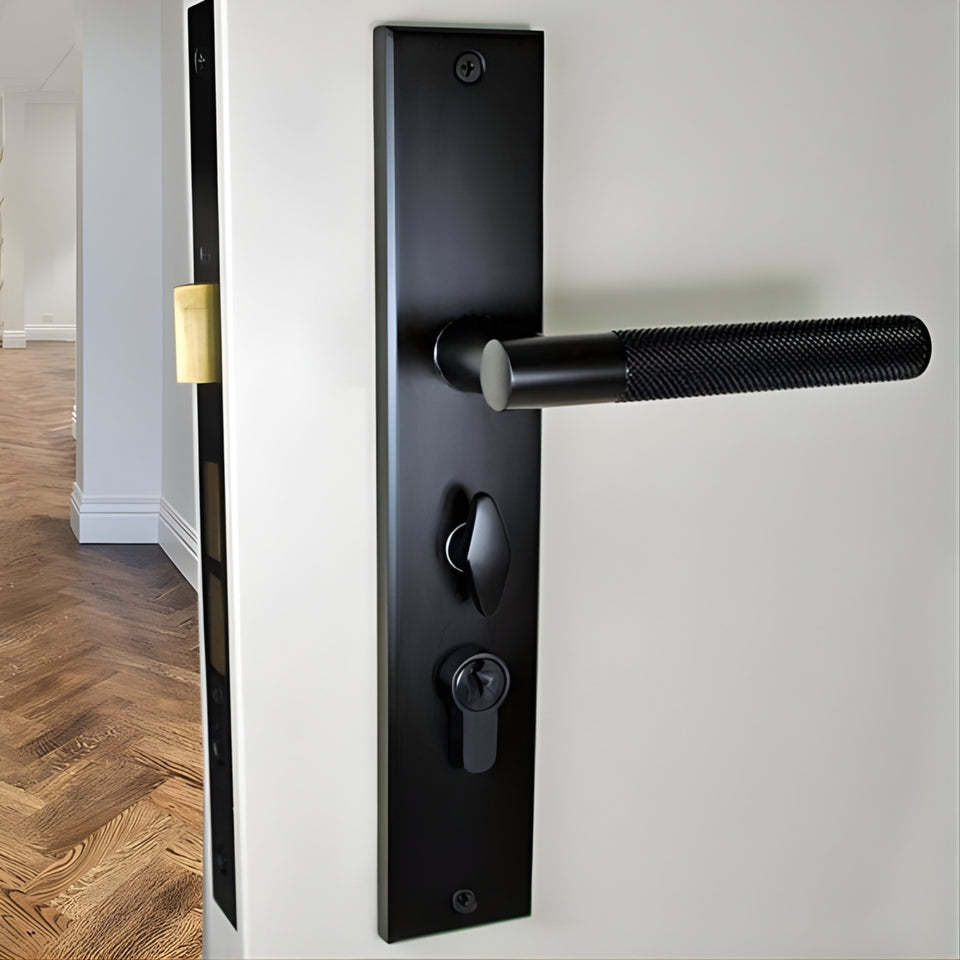
Exterior door levers buying guide
On a front door a lever set carries the lock, and the way a set is sold decides what you still have to buy. Some sets arrive with the mortice lock, cylinder and keys. Some list the lock as a separate item. Some build the key into the lever, and some pair a lever with a deadbolt in one box. Below are those formats, what each box holds, the fit numbers on the product pages and the checks that stop a set arriving that will not fit the door. For the shorter overview of lock sets by type, see entry door lock sets, and for lever styles across the house see door levers.
Are door handle sets universal
No. The backset, the distance from the door edge to the centre of the hole, has to be measured and compared with the mechanism supplied, and matching the backset alone does not mean a replacement will fit. It tells you to check the supported door thickness and whether spacers or spin rings are needed, since requirements differ between ranges, and to follow the range's diagram where handing is an option. The same checks apply to a front door: the lock, the door thickness, the backset and the existing door preparation.
The product pages follow that pattern. Iver and TradCo kits suit doors 35 to 60mm thick. Zanda sets suit 35 to 53mm, and the Zanda Vertex for 35 to 45mm. Lane and Lockwood Nexion sets suit 35 to 45mm, and Nidus Spring and Collins for 34 to 45mm. Most sets use a 60mm backset. The TradCo kits list 57mm, and the Lockwood Nexion lists a 60mm standard backset with a 70mm latch available as an accessory. Measure your door before you choose a range.
Lever and lock together: the formats
The same lever shape can come in several formats, and the product title and box contents show which.
A lever kit with the lock supplied. The TradCo Reims, Milton, Menton and Victorian entrance sets and the Iver Baltimore, Helsinki, Brunswick, Sarlat and Osaka kits with a high security lock list a Euro mortice lock. The TradCo sets list three keys and a key and key cylinder. The Iver kits list two keys and a key and thumb cylinder. The Zanda Zurich entrance set lists two levers, a Euro round escutcheon, a Euro double cylinder in 60mm key and turn, a Euro mortice lock with an 85mm pitch and a 60mm backset, and three keys. The Zanda Vertex entrance sets list two levers, a Euro mortice lock, an escutcheon, a cylinder, fixings and fitting instructions, in single and double cylinder versions.
A lever kit with a separate lock. The Iver Puerto, Helsinki, Baltimore, Osaka and Sarlat round rose entrance kits are titled "with separate high security lock". The lock is a separate item, so read the box contents, a pair of door levers, a fixing kit and instructions, and confirm what lock you need before you order.
A lever set only. The Zanda Zurich fluted and hammered lever sets only list the levers and instructions, with a spindle on the tubular version. You add the lock yourself.
A key in lever set. The Nidus Spring and Collins entrance key in lever sets list a single lever set, doors 34 to 45mm thick, a 60mm backset, a 60mm projection and a 128mm lever. The Nidus combination entry and deadbolt sets list the same lever set, with a deadbolt function.
A multifunction set. The Zanda Kent Knox and Epic Knox sets are multifunction entrance sets with a double cylinder and a Euro mortice lock, for doors 35 to 53mm thick.
A mechanical entrance lock. The Lockwood Nexion L-series sets list levers and backplates, a box strike with a concealed crossgrain doorframe strengthening screw, an installation template and two keys, with a 5 pin tumbler cylinder and 6 pin capability, for doors 35 to 45mm thick.
A Lane entrance set. The Lane Victoria and Avalon entrance sets list two levers, a latch, a strike, fixings and three keys. The Lane Corvan single cylinder sets use a deadbolt latch with a single key and turn cylinder.
Single or double cylinder
The cylinder decides what the inside of the door does. A single cylinder lock, keyed outside with a thumb turn inside, is the most common arrangement. A double cylinder needs a key on both sides, which suits a door with glass nearby, because someone who breaks the glass cannot reach a thumb turn. The trade-off is simple. A single cylinder lets you leave quickly, but a broken window near the turn gives access. A double cylinder removes that gap, but in an emergency you need the key to get out, so keep a spare key near the door where an intruder cannot reach it. Some areas restrict double cylinders for fire safety, and double barrel locks are a fire risk on emergency exits.
The Zanda Duke and Boston entrance sets are single cylinder with a 70mm key and turn cylinder. The Zanda Oxford, Zurich and Cambridge entrance sets list a double cylinder, key and key, at 70mm. The Vertex comes in both. An interconnect set is one where the inside handle retracts the latch and the deadbolt together, and a dummy set is one with no working lock or latch, used to match the inactive leaf of a double door.
Keys and keying
The number of keys differs by range. The TradCo kits and the Lane entrance sets list three keys, the Iver kits and the Lockwood Nexion sets list two, and the Zanda Zurich entrance set lists three. The Zanda sets are keyed different, so each set has its own key. The product pages do not set out keying options such as keyed alike, so ask before ordering if you want one key for the front and back doors. Keep a spare key for a double cylinder lock where an intruder cannot reach it.
Why a lever lock needs a deadbolt beside it
Knob or lever locks are not suitable as the primary door lock, and a deadbolt extends into the frame. The lever handles the latch and the key, and the deadbolt does the securing, so on a front door plan a deadbolt as well, from deadbolts, Lockwood deadbolts or Lane deadbolts. The Nidus combination sets and the Zanda multifunction sets already combine a lever with a deadbolt function, and they are collected on Zanda multifunction entrance sets.
Lever or knob
Levers suit most doors, because they push down to release the latch and come in the widest range of shapes, and most ranges offer matching passage, privacy, dummy and entrance versions. The lever is the most common type, and levers usually take less effort than knobs. Knobs suit heritage homes, and a knob should be comfortable for everyone who uses the door. This page is levers. For knobs see door knobs, and for period styles see heritage door hardware.
Double doors and the inactive leaf
A pair of doors needs a plan. Put an entrance handle on one leaf so both can be locked, a passage handle on the other, and bolts at the top and bottom of the passage leaf. A dummy set is the way to match the inactive leaf. Choose the active set first, then the second leaf and the bolts. See dummy door handles and passage door handles.
Materials and finishes
The materials are on the product pages. The Iver and TradCo kits are solid brass, with lacquered, powder coated or PVD finishes depending on the product page. The Zanda Zurich sets are brass. The Zanda Vertex sets list stainless steel. The Lane, Nidus and Lockwood Nexion sets list zinc alloy or zinc die-cast. Unlacquered brass develops a patina, lacquered brass should only be wiped, and chrome shows fingerprints and water spots more readily than brushed finishes. An outdoor door takes more weather than a bedroom door, so confirm the coating and maintenance before buying near the coast.
The finish pages are matte black, brushed nickel, chrome, brass, satin brass, gold, bronze and gunmetal.
Smart locks
Some entrance doors take a keypad or app lock. Smart locks are usually battery powered and should keep a mechanical backup. The Zanda Stealth smart lock longplate is an electronic mortice lock for doors 35 to 65mm thick with a 60mm backset. See smart door locks and digital smart entrance sets.
Before you order
Write down five things for the door: its thickness, the backset, the size and position of any existing holes, whether it is single or double, and which way it opens. Then read the product page's title and box line for the lock format, the cylinder and the keys. If handing is unclear, photograph the hinges and note the direction of opening. Confirm the finish name against the rest of the hardware too, because finish names vary between brands.
Fitting
Correct alignment and hinge notching are difficult, so use an accredited, licensed and insured locksmith for lock work. A mortice lock sits in the door edge, so it is not a quick swap. Solid doors and steel frames are the base for exterior locks. The bolt must enter the frame fully and the screws must reach solid timber.
The ranges and where they sit
Each range has its own page. Zanda and Zanda Duke entrance sets cover the Zanda sets. Iver and TradCo cover the brass kits. Lockwood and Lane cover the Nexion and Lane sets, and Nidus covers the key in lever sets. For a pull handle entrance instead of a lever, see entrance pull sets and pull handles, and for the wider outdoor choices see exterior door handles and hardware.
A door-by-door list
Make a list of every door with its room, function and finish, with the extras each needs. For an entrance door, add the lock format, the cylinder type, the door thickness and backset, and what is in the box. Choose hinges and door stops with the lever, from hinges and door stops. The full range is on door hardware and door handles.
Questions about exterior door levers
What are door levers called?
The handle you press down is a lever, and the set that pairs it with a lock is an entrance lever set. Each set has a function: an entrance set has a keyed lock, a privacy set locks from inside, a passage set has no lock, and a dummy is fixed. For an external door you want the entrance function, because it is the one that locks with a key.
Which is better for an external door, a knob or a lever?
Each has trade-offs. A lever is pressed down and is easier to use, and it opens with an elbow when your hands are full. Knobs give less grip, which is harder for children, older people, people with a disability and anyone with wet hands, but a knob is compact, traditional and less likely to catch clothing. Loose clothing can catch on a lever. For a front door that many people use, the easier grip of a lever is the stronger case.
Do I still need a deadbolt?
A knob or lever lock should not be the primary lock on an external door. Home security advice is to add a deadbolt or deadlock beside it. The deadbolt extends into the frame, and the lever lock handles the daily latching. See deadbolts.
Are door handle sets universal?
No. Check the backset, the thickness, the hole size and the handing, and make sure a new rose covers the old preparation. Matching the backset alone does not mean the set will fit.
Fit numbers by range
Each range has its own fit numbers. The Iver and TradCo entrance sets suit doors of 35 to 60mm, with a 60mm backset on the Iver and 57mm on the TradCo. The Zanda Duke, Oxford, Zurich and Boston sets suit 35 to 53mm doors with a 60mm backset and a 70mm cylinder, the Zanda Vertex suits 35 to 45mm, and the Lane and Lockwood Nexion sets suit 35 to 45mm. The Nidus sets suit 34 to 45mm with a 60mm backset. Measure the door across the edge, and measure the backset from the door edge to the centre of the hole, not across the hole itself.
What is in the box
The Zanda Zurich entrance set holds two levers, an escutcheon, a euro double cylinder, a euro mortice lock and three keys. The Zanda Vertex box lists two levers, a euro mortice lock, an escutcheon, a cylinder, fixings and fitting instructions. The Lane Victoria and Avalon sets list two levers, a latch, a strike, fixings and three keys. The Lockwood Nexion lists levers and backplates, a box strike with a concealed crossgrain doorframe strengthening screw, an installation template and two keys. Read the box line for the exact set so that the lock is not missing on the day.
Materials for a door that faces the weather
Materials differ by range. The Iver and TradCo sets and the Zanda Zurich are solid brass. The Lane sets, the Lockwood Nexion, the Nidus sets and the Zanda Duke are zinc alloy, and the Zanda Vertex and Boston are stainless steel. The Iver and TradCo sets come in lacquered, powder coated and PVD finishes. For a door that faces the weather or the coast, read the finish line of the product page and confirm the coating before you choose the colour.
A dummy partner for a double door
On a pair of doors, one leaf takes the entrance set and the other leaf takes a matching dummy handle, with bolts at the top and bottom to hold it. On French doors the entrance handle can go on one leaf and a passage handle on the other. Dummy handles are on dummy door handles.
The entrance and lever sets on this page come from Iver (Sarlat, Helsinki, Osaka, Baltimore, Brunswick and Puerto) and Zanda (Oxford, Zurich in fluted, hammered and entrance versions, Duke and Vertex 70mm). Check that the set suits an external door before you order, and choose the cylinder at the same time as the lever.
Cylinders by set
The Zanda Duke and Boston sets are single cylinder, key and turn, with a 70mm cylinder. The Oxford and Zurich sets are double cylinder, key and key, also at 70mm. The Vertex comes in single and double versions. Choose key and turn if you want to leave without a key, and key and key where glass sits close to the door. The Zanda Stealth smart lock longplate is a smart option for the same doors, with fingerprint, code and Bluetooth unlocking, and a mechanical backup is worth keeping for any battery powered lock.
An exterior lever set works with a lock, so choose the two together. Decide first whether the door needs a deadbolt as well as the latch, then check that the lever, the lock and the strike all suit the door thickness and the backset. If the door is new, give the door maker the full specification before the door is cut, and ask for the holes to be drilled in the workshop where the setting out is easier.

