


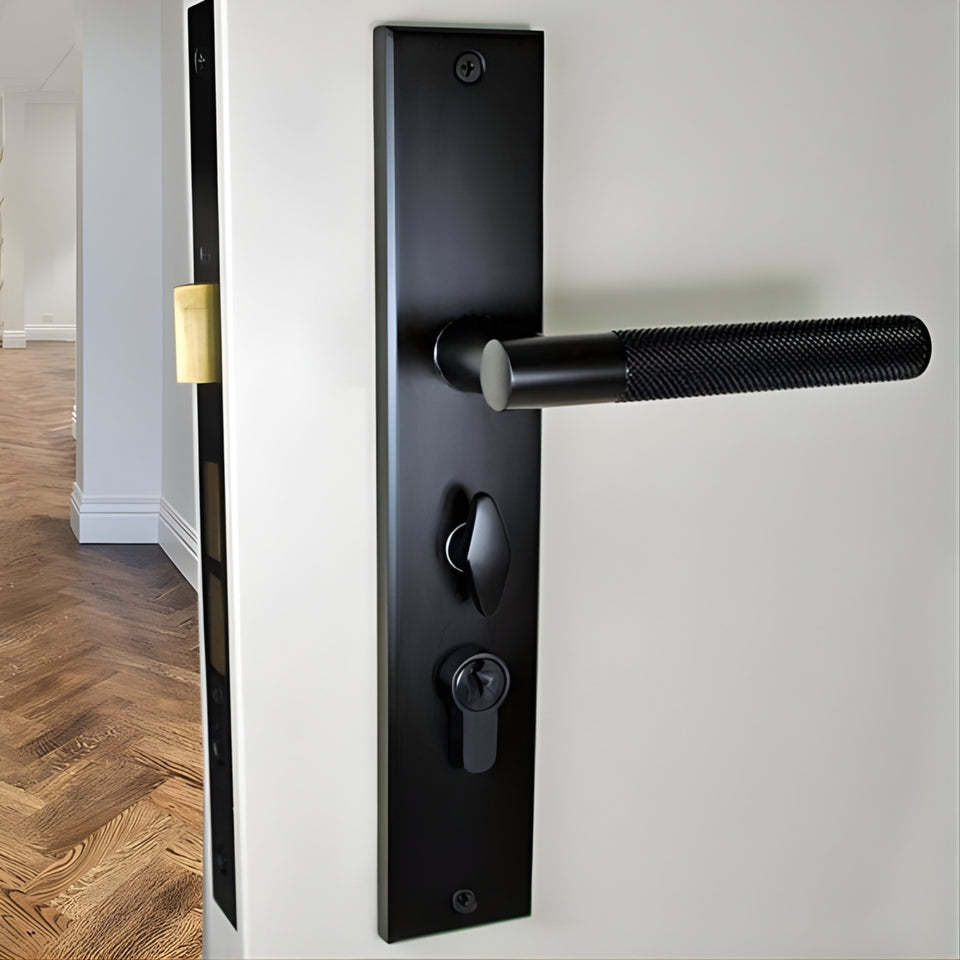
Exterior door handles and hardware buying guide
An exterior door handle does two jobs at once: it opens the door and, with a lock, secures it. The choice starts with how the door opens and locks, then moves to the material, the finish and the numbers that decide fit. This collection holds entrance hardware for front, entry and external doors: lever sets with key locks, pull handles, deadbolts, mortice and Euro locks, sliding door sets, smart locks and screen door hardware. This guide sets out the types, how a replacement works, which materials suit outdoor use, and which measurements to take before you order. For interior doors, see door handles and door hardware.
What an entrance handle is
An entrance handle is a lever, knob or pull handle paired with a lock that takes a key. The common forms are an entrance lever set with its own latch and cylinder, a pull handle with a separate lock kit, and a deadbolt fitted beside a handle. Front door hardware comes in the same groups: entry door pulls, roller, mortice and Euro locks, and pull and lock sets. For lever and knob entrance sets, see exterior door levers. For the locks themselves, see entry door lock sets.
Choosing between a lever, a knob and a pull
The decision follows the door. A lever or knob set has a latch, so the handle operates it, and the key lock secures the door. A pull handle has no latch, so the door is held shut by the lock alone, and the pull is fixed back to back through the door. The factors to weigh are comfort, strength and weatherproofing, quality, design and functionality, such as keyless entry. It also suggests handles that comply with AS 1428 and contoured grips for an easier hold. Choose a lever or knob where the handle must turn a latch, and a pull where the door is large and the handle is a design feature.
Entrance lever sets and their numbers
The numbers that decide fit. The Lane entrance sets come with three keys and suit doors 32 to 45mm and 35 to 45mm thick, depending on the range. The Zanda Duke entrance sets use a 70mm Euro cylinder, key and turn or key and key, a Euro mortice lock, a 60mm backset and doors 35 to 53mm thick. The Lockwood Nexion mechanical entrance locks use a 5 pin tumbler cylinder, a 60mm standard backset with 70mm available as an accessory, a 13mm brass bolt and doors 35 to 45mm thick. The Nidus Collins and Spring entrance sets suit doors 34 to 45mm thick on a 60mm backset. The Iver entrance kits list two keys, a Euro mortice lock, a 60mm backset and doors 35 to 60mm thick, and the TradCo entrance sets list three keys, a 57mm backset and the same 35 to 60mm door range. See Lane door levers, Zanda multifunction entrance sets, Lockwood door levers, Nidus door hardware, Iver door hardware and TradCo door hardware.
Pull handles
Pull handles are sold in sets for back to back fixing through the door. The Zanda round pull handle comes in 600mm with 400mm centres and 900mm with 700mm centres, with a 76mm projection, and AS 1428 compliance. The Momo Bellevue, Belgravia and Aspen pulls are brass, suit doors 35 to 50mm thick, and range from 496mm to 600mm with fixing centres of 416mm to 525mm. The Lockwood entrance pull handles are 304 grade stainless steel and suit external environments. Measure the fixing centres you need, not only the overall length, because the centres set where the through-bolts go. See pull handles, Zanda door pull handles and Momo architectural door hardware.
Deadbolts
A deadbolt adds a bolt that the key throws, in addition to a handle's latch. The Lockwood 005 double cylinder round deadbolt lists an adjustable stainless steel bolt for backsets from 60 to 70mm, and doors 32 to 48mm thick, with a spacer ring included for 32 to 36mm doors. The Lane deadbolts list a 60 to 70mm adjustable bolt for a 54mm cross bore on doors 32 to 45mm thick, with three keys. The Zanda slimline deadbolts are stainless steel and list a minimum door thickness of 35mm. A single cylinder deadbolt is keyed from outside and turned from inside, and a double cylinder is keyed on both sides. See deadbolts, Lockwood deadbolts and Lane deadbolts.
Smart locks and keyless entry
Some entrance hardware is electronic. The Yale smart locks include digital deadbolts and mortice locks, the Yale Luna Pro and Kyra Pro push and pull mortice locks for doors 35 to 100mm thick on a 60mm backset, and the Yale Unity entrance lock. The Lane Grande electronic IC cards belong to the Lane electronic lock system. Smart locks differ in door preparation, power and thickness, so read the product page for each. See smart door locks and digital smart entrance sets.
Sliding and screen doors
Sliding doors and screen doors need hardware made for them. The Nidus lockable sliding cavity door entrance sets suit doors 35 to 55mm thick on a 60mm backset. The Yale Quattro hinged security door lock is a screen door lock for a standard 20mm door, and the Lockwood hydraulic screen door closer suits heavier screen doors. See sliding door handles, screen door hardware, screen door locks and screen door closers.
Material and finish for outdoor use
The base metal and the finish both matter outdoors. Aluminium, stainless steel, chrome and powder-coated steel suit exterior doors because they resist rust and corrosion and need little maintenance. 316 marine grade stainless steel, and the Lockwood pull handles are 304 stainless steel. The Iver and TradCo sets are brass with a lacquered, powder coated or plated finish, and the Lane, Nidus and Zanda lever sets are zinc alloy or stainless steel. Read the material line and the finish line on each product page, because two handles in the same colour can have different bases. For finishes, see matte black door handles, brushed nickel door handles, stainless steel door handles, brass door handles, chrome door handles and gun metal door handles.
Can you replace a front door handle
Usually yes, if the new handle matches the old fittings. Measure the backset, the lock centres, the fixing centres, the door thickness and the spindle, because handles can look alike and still differ in fixings, springing or spindle connection. The new plates must cover the old cut-outs, the latch slot must be smooth and deep enough for the new latch, and the strike plate must line up. Replacement is harder with integrated lock and handle systems, with old or obsolete models, and with complex multi-point locks, where the whole lock set often needs replacing. Do not drill through a fitted lock case to make incompatible screw positions work, and check the door's certification before changing hardware on a fire door. If in doubt, ask a tradesperson, especially for entry handles.
Are front door handles a standard size
No. Backsets are 57mm, 60mm or an adjustable 60 to 70mm. Door thickness ranges from 32mm to 60mm depending on the maker. Pull handles run from about 300mm to more than 1,800mm, with their own fixing centres. The 60mm backset is the most common in this collection, and the Lockwood Nexion locks list 70mm as an accessory. Measure your door, and match the numbers on the product page.
Keys, cylinders and what is included
Read what the box holds, because entrance sets differ. The Lane entrance sets include three keys and a C4 five-pin cylinder on the Bala entrance knob, which can be keyed to suit your requirements. The Zanda entrance sets are keyed differently and list the cylinder length and type. The TradCo sets list three keys and a key and key cylinder, and the Iver sets list two keys and a key and thumb cylinder. The Lockwood Nexion locks list a 5 pin tumbler cylinder, and the Nidus Mardeco Euro lock sets are sold with the cylinder as a separate item on some product pages. A key and turn cylinder is keyed outside and turned inside,, and a key and key cylinder needs a key on both sides. Choose the cylinder type that suits how the household leaves and enters.
Door thickness and the hole
Door thickness decides which sets can be used. The Iver and TradCo sets suit doors 35 to 60mm thick, which covers thick timber doors, and the Yale mortice smart locks suit doors 35 to 100mm. The Zanda and Lockwood sets suit 35 to 53mm and 35 to 45mm. The Lane and Nidus sets suit 32 to 45mm and 34 to 45mm. The hole matters as well. A 50 to 54mm cross bore for the rose, and the Lockwood Paradigm pull handle lockset lists a 54mm hole, a 16mm hole and a 25mm side bolt hole. A rose that is too small leaves the old hole showing, and the new plates must cover the old cut-outs.
Accessible grips
Choose handles that comply with AS 1428, the Australian standard for design for access and mobility, and contoured handles for an easier grip. Some products in this collection carry a compliance rating. It, and compliance with AS 1428 disabled access regulations. Check the product against the standard for your project if compliance is a requirement.
Common mistakes
The same few errors come up again and again. The first is ordering by colour and finish before checking the door thickness and the backset. The second is assuming any handle fits any lock: handles that look alike can differ in fixings, springing and spindle connection. The third is drilling through a lock case to force a screw position, which you should avoid. The fourth is forgetting the cylinder, when the set is sold without one. The fifth is fitting a screen door lock to a solid door, or the reverse. Each is avoided by reading the specification and the box contents.
Hinges, stops and the rest of the door
Keep the hinges and stops in the same finish as the handle. See hinges and door stops. For a period home, see heritage door hardware.
Our recommendation
Start with how the door opens and locks, then choose the type. Use a lever or knob set where the handle turns a latch, a pull with a lock kit where the door is large, and a deadbolt or smart lock where the lock is the point. Read the material and finish line, choose 316 stainless or a coated brass for the weather, and match the finish across the handle, lock and hinges. Measure the thickness, the hole and the backset, and read the box contents for keys and cylinders. That order avoids the common mistakes: a handle that does not match the old fittings, a set made for the wrong door thickness, and a screen door lock fitted to a solid door.
Questions about front door handles
What is a front door handle called?
It is an entrance handle: a pull, lever or knob that works with a key lock. The lock can be a euro mortice lock, a deadbolt, a roller lock or a smart lock, and the handle is chosen to suit it. On a product page the useful term is the function, entrance, because it tells you the set includes a lock.
Are front door handles a standard size?
No. There is no single size, so measure the door. Check the door thickness, the backset, the hole spacing and diameter, and the spindle, and look at the escutcheon that covers the preparation. The product pages in this collection give 35 to 60mm doors and a 60mm backset on the Iver sets. The Zanda Duke, Oxford and Vertex sets list 35 to 53mm and 60mm, with a 70mm euro cylinder. Lane and the Lockwood Nexion list 35 to 45mm.
Can you replace a front door handle?
Usually yes, if the backset, hole spacing, thickness and spindle match the old set. It is harder when the door has an integrated or multi-point locking system, because the handle is part of the lock. Do not drill through a lock case, and note that a fire door needs certified hardware. If a swap does not fit, the better route may be a new set with a matching rose or escutcheon.
Can I swap the handle without changing the lock?
On a standard door the answer is often yes, because the handle and the lock are separate parts joined by the spindle. On integrated systems the two are one unit, so change them together.
Choosing for the weather
A front door is exposed, so the material matters. 316 marine grade stainless steel for indoor and outdoor use, and the Lockwood entrance pull handles are 304 stainless steel for external environments. The Iver and TradCo sets are lacquered brass, and the zinc alloy levers use plated or powder coated finishes. Read the material and finish lines of the product page, and choose a finish that suits the position of the door.
The levers and knobs on this page come from Iver (Helsinki, Sarlat, Osaka, Baltimore, Brunswick and Cambridge), Zanda (Zurich, Oxford entrance sets and Duke pulls), Nidus Mardeco and Momo. Choose the range from the door style first, then check the finish against the weather the handle will face, because an entrance set, a lever and a pull may each come from a different range.
Pulls, deadbolts and smart locks by number
Pull handles are sized by length and fixing centres. The Zanda round pull comes in 600 and 900mm lengths. The Bellevue, Belgravia and Aspen pulls suit doors of 35 to 50mm. A pull does not lock the door, so it pairs with a lock kit or a separate lock, and the product page tells you which.
The Lockwood Nexion entrance set has a 60mm backset and a five pin cylinder for doors of 35 to 45mm. The Lockwood 005 deadbolt has a double cylinder and an adjustable 60 to 70mm bolt for doors of 32 to 48mm. A knob or lever lock should not be the main front door lock, so add a deadbolt or deadlock alongside it.
Smart options include the Yale Assure, Libi, Luna Pro+, Kyra Pro and ByYou Pro, the Zanda Stealth, and the Lane Grande IC cards. The push and pull mortice locks suit doors of 35 to 100mm with a 60mm backset. See smart door locks for the detail.
Exterior hardware works harder than interior hardware, so check a few extra things. Look at how the door is protected: a deep porch gives hardware an easy life, while a door that takes weather and afternoon sun wears its finish faster. Wipe the handle and the lock with a soft cloth when you wash the windows, and rinse salt and dust off before they sit. Check the fixing screws once a year, since a door that is opened and closed many times a day loosens its fixings sooner than a bedroom door does.

