


In Stock Cabinet Handles
5 Items
-
In Stock

Sold out Meir Oppen Round Pull 328mm Cabinet Handle Tiger Bronze
Checking delivery...$86 -
In Stock

Sold out Meir Oppen Round Pull 200mm Cabinet Handle Shadow
Checking delivery...$61 -
In Stock

Sold out Meir Oppen T-Pull Cabinet Handle Knurled Brushed Nickel
Checking delivery...$31 -
In Stock

Sold out Meir Oppen Round Pull 200mm Cabinet Handle Knurled Tiger Bronze
Checking delivery...$61 -
In StockItalian Made
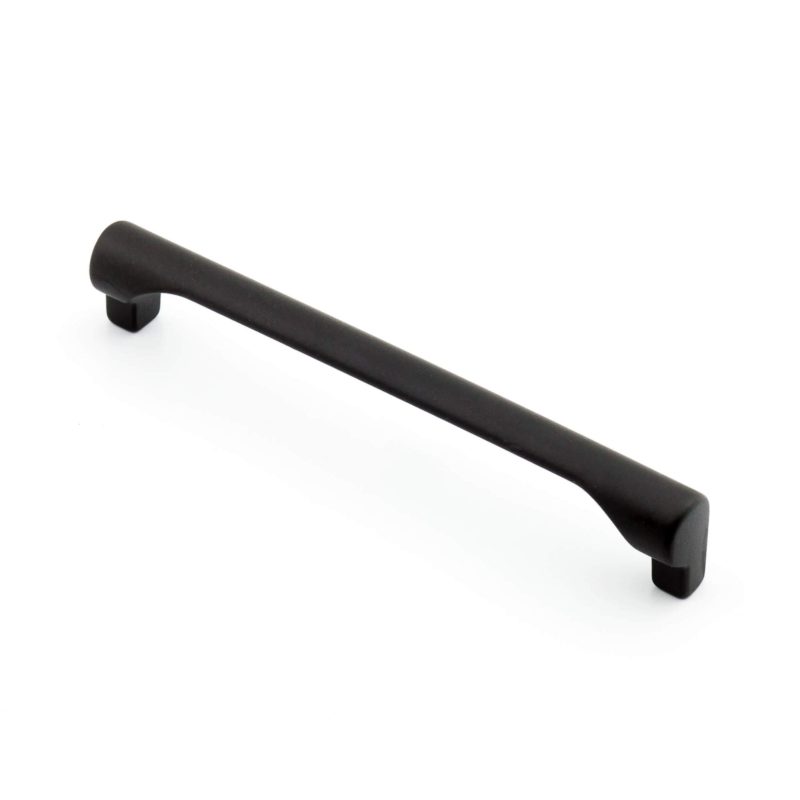
Sold out Castella Terrace Pull Handle Matt Black
Checking delivery...$56


Cabinet Handles Buying Guide
This page holds a mixed selection of cabinet handles: D handles and bar handles, knobs, cup pulls, lip pulls, T-pulls and long bars, in zinc alloy, stainless steel, aluminium and solid brass. Finishes run from brushed nickel and brass to black, white and bronze. A mixed selection is a different job from a single range page, because the pieces come from different makers and do not share a size chart. The sensible order is to measure the centres first, then pick the type for the door or drawer, then the size, the material and the finish, and finally fit and look after the handle. For the full range of handles, start at cabinet handles.
Start with the centres, not the length
The number that decides whether a handle fits an existing cabinet is the centre-to-centre distance, also called the fixing distance: the gap from the centre of one screw hole to the centre of the other. An Australian retailer's guide calls this the critical number when ordering, and not the overall length of the handle. It lists the common spacings as 32mm, 64mm, 96mm, 128mm (the most common), 160mm, 192mm, 256mm, 320mm, 384mm and 448mm. It adds that a handle sold as 160mm often has 128mm centres, and it names ordering by overall length instead of centres as the first common mistake.
The listings on this page show the same pattern. A handle that is 169mm long can sit on 128mm centres, and a handle that is 200mm long can sit on 160mm centres. Measure the holes in your door before you shop, then read the fixing distance on each listing. A handle supplier's size guide says centre-to-centre can be as little as 9mm under overall length for a tight D handle, and 80mm to 90mm under for a long tapered bar. For a new cabinet, decide the centres first and brief the cabinet maker.
Choose the type for the door or drawer
The Australian guide sorts handles into types, and a handle retailer's guide adds what each suits. The mix on this page covers most of them.
- Bar and D handles run from 96mm to 600mm or more overall and suit drawers, overhead cabinets and pantry doors. A handle retailer says straight D handles suit traditional and modern kitchens and bathrooms. See D shaped cabinet handles and cabinet pull handles.
- Knobs are single-point fixings, best on doors and small drawers. A retailer that explains knobs against pulls says they are gripped with the fingers and take a single screw, while pulls are gripped with the whole hand and suit large or heavy doors and drawers. See cabinet knobs.
- Lip pulls, also called half-moon or edge pulls, are recessed, low-profile pulls for lower doors and drawers. A handle retailer says they are installed along the edge of the door, which makes them almost invisible from the outside. See lip pull handles.
- Cup or bin pulls are curved pulls for Shaker, farmhouse and mid-century kitchens, where your fingers curl underneath. See cup pull cabinet handles.
- Appliance pulls are large, heavy-duty handles for bigger doors such as integrated fridges. The Australian guide puts them at 600mm and above for fridge panels and tall pantry doors. See appliance pull handles.
A handle retailer also describes knurled handles as having a pattern that gives them a unique feel and makes them easier to hold, even with wet hands. It lists round and half-moon pulls as a fit for furniture such as bathroom vanities and wardrobes.
Choose the size for the cabinet
The Australian guide gives a sizing table for standard cabinetry. A standard drawer 450mm to 600mm wide takes a pull on 128mm to 160mm centres. A wide drawer, 600mm to 900mm, takes a pull on 256mm to 320mm centres, or two pulls on 128mm centres. A standard door about 600mm wide takes a pull on 96mm to 128mm centres or a single knob. A tall pantry or full-height door takes a pull of 600mm or more, or two 256mm pulls stacked, and an upper cabinet door takes a 96mm pull or a knob. Vanity handles most commonly use 96mm or 128mm centres.
A widely used rule agrees. A hardware retailer's guide says a pull is about one third the width of the drawer front, so a drawer 600mm wide takes a pull of about 200mm. Another size guide gives examples: a 300mm drawer takes a 100mm handle, a 450mm drawer 150mm, a 900mm pot drawer 300mm and a 1,200mm island drawer 400mm. A US hardware maker adds that you should avoid undersized pieces that feel disconnected and oversized hardware that dominates unnecessarily.
You can test the size before you buy. The Australian guide suggests taping strips of the handle length to the cabinet face for a day, and a paper circle does the same job for a knob. A knob size guide from a hardware supplier puts most cabinet knobs at roughly 25mm to 38mm across, and the round knobs on this page sit in that range.
Choose the material for the room
This page covers zinc alloy, stainless steel, aluminium and solid brass. Each has a job, and each has a limit.
Zinc alloy, usually zamac, is the most common handle metal. A reference article describes it as a family of alloys of zinc, aluminium, magnesium and copper with excellent castability, and a UK maker calls it a lighter alternative to brass that is durable and keeps a consistent finish. The finish does the protecting. Engineers on a metal finishing forum say die-cast zinc handles must have a corrosion-proof finish, plated or powder coated, because uncoated zinc shows white rust and corrosion pits. See zinc alloy cabinet handles.
Stainless steel is the durable choice for humid rooms. A reference article explains that it needs at least 10.5 per cent chromium, which forms a thin protective film that repairs itself even when scratched, and that type 316 adds molybdenum for pitting resistance. Near the coast, the Australian Stainless Steel Development Association says grade 316 should be the minimum within about five kilometres of the surf. See stainless steel cabinet handles.
Aluminium is the lightest. A UK maker calls it significantly lighter than brass and zamac, and reference sources say its natural oxide layer protects it from corrosion. Its density is 2.70 g/cm3, against about 6.7 g/cm3 for the common zinc alloy and 8.4 to 8.73 g/cm3 for brass. See aluminium cabinet handles.
Solid brass is the heaviest. A handle supplier says brass is heavier than zinc alloy or aluminium of the same size, and that weight is the difference people notice first. Bare brass darkens, so makers add a finish, and a brushed brass handle is solid brass under a clear lacquer, so a scratch shows more of the same brass. See solid brass cabinet handles.
Bathrooms and other humid rooms
The Australian guide advises solid brass, stainless steel or quality PVD finishes for bathrooms because of the humidity, and warns against thin electroplated zinc alloy in shower splash zones. That is one retailer's view and not a test. The same guide recommends coordinating the handle finish with the tapware. A UK door furniture retailer advises wiping and drying bathroom fittings more often than those in other rooms, because steam and moisture leave marks. The cabinets these handles fit are at bathroom vanities and furniture.
Choose the finish
The finish decides the look and how the handle wears. A reference article describes physical vapor deposition, PVD, as a vacuum method for making thin coatings. It says varying the process gives a range of colours on stainless steel, including finishes that resemble brass or bronze, and that PVD coatings are sometimes harder and more corrosion-resistant than electroplated coatings. The Australian guide calls PVD the most durable finish for kitchen hardware. A second Australian retailer's finish guide says thin electroplating on zinc alloy typically shows wear at grip points within 18 to 24 months of daily use, and that powder coating, standard for many matte finishes, can chip at corners if handles are knocked.
- Matte black is the most specified contemporary finish, and the guide says it hides fingerprints better than polished finishes. Finish guides and a cabinetry maker disagree and say dark matte can show oily marks, so test a sample. See black cabinet handles.
- Brushed and aged brass suit warm palettes, and the guide says aged brass suits Hamptons and heritage kitchens. See brushed brass cabinet handles.
- Brushed or satin nickel is cool-toned and versatile, and the guide says it pairs with stainless steel appliances. See brushed nickel cabinet handles.
- Chrome in a brushed form is easier to maintain than polished, according to the guide.
Mix metals with care
The Australian guide advises anchoring with one dominant finish and adding a second as an accent. It limits the palette to two metals and keeps warm metals (brass, bronze) together and cool metals (nickel, chrome) together. A hardware retailer's rule is to repeat each metal at least twice so it reads as a choice, and a US hardware maker adds that coordinated finishes need not be identical. The pieces on this page come from different makers, so put two handles side by side before you order a whole run. A finish name can look different from one maker to the next.
Handles for bathroom and bedroom furniture
Furniture is a different job from kitchen cabinetry, because the drawers are narrower and the pieces are often smaller. An Australian placement guide says drawers under 300mm wide take a pull of 70mm to 100mm or a 25mm knob, and that knobs make a smaller room look less busy and fix with one screw. A handle retailer lists round and half-moon pulls as a fit for furniture such as bathroom vanities and wardrobes. A restoration retailer adds that half-moon pulls, also called bin or cup pulls, are comfortable to grip from below because of the large surface area, and strong enough for heavy drawers. It says mixing them with knobs is acceptable if you assign each style a function and keep one finish.
For a dresser, wardrobe or vanity the order is the same as for a kitchen. Measure the centres of the existing holes, pick a type for each door and drawer, then match the size to the front. A vanity drawer most often takes 96mm or 128mm centres, according to the Australian guide, and a wardrobe door takes a longer vertical pull or a knob. See bathroom vanities and furniture.
Colour and character
Most handles on this page are metal in neutral or metallic finishes, with some in white, black and bronze and a few in colour. Design writers are cautious about colour. A design magazine says black, gold and other neutrals suit most spaces while coloured handles can add personality or contrast. A kitchen designer writing for Houzz Australia in 2017 says coloured handles are a way to get a bolder contrast on white cabinetry, and a furniture manufacturer's blog, which is promotional, suggests soft muted tones for an understated look. The shared advice is to treat a coloured handle as an accent and to hold a sample against the door in the room's own light, because colour shifts with the light.
Finger pulls and handleless options
If you do not want a visible handle, there are two routes. The Australian guide describes edge or finger pulls as recessed channels for minimalist and handleless cabinetry, and a handle retailer says lip or edge pulls are almost invisible from the outside. For integrated appliances, Fisher and Paykel makes an assisted opening accessory that opens doors without a handle, and Miele makes a dishwasher that opens when you tap twice on the front. A visible handle is still the simplest route for most cabinets, and it is the one this page covers.
Common mistakes
The Australian guide lists the errors it sees most often. Buyers order by overall length instead of centres, buy online without seeing finishes in person (colours vary between screens), and choose trends over longevity. Others underspecify handles for appliance doors, or choose hardware before confirming the cabinetry colour and the benchtop. The first is the costliest, because a handle with the wrong centres needs new holes. The last is the easiest to avoid, by choosing the handle after the colours are settled.
Fitting the handles
Check whether screws are included. The listings on this page differ: some state that screws are included and some state that they are not. A hardware supplier's example shows how screw length follows panel thickness, with a 22mm screw for panels 16mm to 18mm thick and a 38mm screw for panels 32mm to 34mm thick. A screw needs to bite into the handle and stop short of the door face.
When replacing existing handles, match the centres and the type. A pull with the same centres goes into the old holes without drilling, while a knob in place of a pull leaves one hole to fill or cover. Mark the holes with a paper template taped to the door before you drill. A hardware retailer recommends the tape test, so you see the handle position before you commit to the holes. The Australian guide also recommends ordering a sample piece before a whole-kitchen order, because colours vary between screens, and looking at the finish in natural and artificial light.
The placement rule is simple. A pull or knob sits 40mm to 60mm from the edge that opens, near the bottom corner of upper doors and the top corner of lower doors. Pulls sit horizontally on drawers and vertically on doors. Check projection and clearance near corners, appliances and adjacent doors.
Caring for the handles
Care depends on the material. For stainless steel, wash lightly and regularly with soap or mild detergent in warm water, rinse and dry, and avoid abrasive cleaners and products with chlorides or bleach. For coated zinc alloy, an Australian retailer advises a soft, dry cloth and no abrasive cleaners or harsh chemicals. For brass, a UK maker says a living finish can be polished and a lacquered one should not be, because brass polish strips the clear coat. For every finish, a UK door furniture retailer advises putting cleaner on the cloth and not on the hardware, and drying immediately to prevent water marks. Wipe the grip area more often than the rest of the handle, since a coating wears first where the hand touches.
A short checklist
- Measure the centre-to-centre distance of the existing holes, or decide it first for new cabinetry.
- Choose the type for each door and drawer: a pull for drawers and large doors, a knob for small doors, a lip or cup pull for a lower profile, an appliance pull for a heavy door.
- Choose the size with the one-third rule and the table above, and tape a paper strip to the front to check it.
- Choose the material for the room, with solid brass, stainless steel or a PVD finish for a bathroom.
- Choose one dominant finish and at most one accent, and match the tapware.
- Check the screws, order a sample and look at it in the room's own light.
Related pages
For the full range of handles, see cabinet handles. For types, see cabinet pull handles, cabinet knobs and appliance pull handles.

